McKinney, Texas – October 4, 2007
“From Camera to Canvas” - A Collaborative Art Exhibit Debuts at Carrie Garner’s Galleria d’Arte
Join us as we embark on a new endeavor at Galleria d’Arte. “From Camera to Canvas” is a collaborative exhibit that combines the talents of Carrie Cameron Garner and Fran Reisner. The exhibit debuts on Saturday, October 13, from 7pm to 10pm at Carrie Garner’s Galleria d’Arte located at 115 South Kentucky Street in downtown McKinney at the old Collin County Prison.
Fran Reisner, a Frisco resident, is a national award-winning master photographer and photographic craftsman, who lives by her philosophy of doing what you love, loving what you do, and doing it with passion. “From Camera to Canvas” will spotlight Reisner’s latest series of photographs taken from recent trips abroad. The perfection and preciseness that Reisner commands from her camera are evident in each of her exquisite photographs. Visit Reisner’s website (www.franreisner.com) to learn more about this consummate professional and her numerous honors and awards.
A believer in painting the beauty that surrounds her, Carrie has created oil painting interpretations of Reisner’s photographs. Carrie’s painting technique, known as oil sculpture or 3-D oil painting, lends itself to bold expressions and vividly colored paintings. The sculptural sections of the painting are created with a palette knife and are formed with pure archival quality oil paint. Once applied, the oil forms a thin “skin” to which a layer of glaze is applied, forming a special coating that protects the paint while giving the sculpted areas the appearance of mouth-blown glass.
The juxtaposition of Reisner’s crisp and sharp photographs to Carrie’s dimensional and textural paintings is both unusual and interesting. This exhibit is guaranteed to pique your interests in both oil painting and photography.
The Quinten Hope Band will provide the perfect accompaniment to the evening’s celebration of the arts and community. Co-sponsors or the event are A Twist of Lime, BLING!, Cadillac Pizza Pub, Market Square Antiques, MeSo Wine Lounge, and Poppy’s Garden Café. Be sure to join us for this new and exciting venture at Galleria d’Arte.
Tuesday, October 02, 2007
Iran slashes oil transactions in dollars
5 hours ago
TEHRAN (AFP) — Iran has slashed the use of the dollar in payment for its oil exports to 15 percent, an official said on Tuesday, amid growing pressure from arch-foe the United States on its financial system.
The vast majority of transactions for oil from OPEC's number two producer are now being carried out in euros, said Mohammad-Ali Khatibi, deputy head of the National Iranian Oil Company in charge of marketing.
"Iran is selling about 85 percent of its oil in the non-dollar currencies," Khatibi was quoted as saying by state television.
"Currently, about 65 percent of the oil sale income is in euros and 20 percent in yen," Khatibi added.
Japan, which purchases 20 percent of Iran's crude oil, has recently agreed to pay for the crude oil in yen, he said.
He also said that the remaining sums being paid in dollars, about 15 percent, are going to shift to "other creditworthy currencies".
Khatibi also cited the United Arab Emirates dirham as one other possible currency for use in oil transactions.
He said the main reason for the move was fluctuations of the dollar on the currency markets and the depreciation of its value since 2004.
Iran had previously announced that 60 percent of its oil transactions for export had been switched into euros.
Iran, the world's fourth largest oil exporter, has massively cut down its dependence on the dollar in the face of US pressures.
The United States has been seeking to make international banking transactions harder for Iran, as another tool to pressure Tehran into backing down over its controversial nuclear programme.
Several European banks have drastically cut business with Iran as a result of US pressure.
However despite problems with inflation and unemployment at home, Iran's economy is being helped by revenue windfalls from current high crude oil prices.
Iran's foreign currency reserves held in banks abroad have risen by 37 percent over the past year to the equivalent of 65 billion dollars as of the end of June 2007, the central bank said in September.
http://afp.google.com/article/ALeqM5...gW2bk5K0eM9G7Q
5 hours ago
TEHRAN (AFP) — Iran has slashed the use of the dollar in payment for its oil exports to 15 percent, an official said on Tuesday, amid growing pressure from arch-foe the United States on its financial system.
The vast majority of transactions for oil from OPEC's number two producer are now being carried out in euros, said Mohammad-Ali Khatibi, deputy head of the National Iranian Oil Company in charge of marketing.
"Iran is selling about 85 percent of its oil in the non-dollar currencies," Khatibi was quoted as saying by state television.
"Currently, about 65 percent of the oil sale income is in euros and 20 percent in yen," Khatibi added.
Japan, which purchases 20 percent of Iran's crude oil, has recently agreed to pay for the crude oil in yen, he said.
He also said that the remaining sums being paid in dollars, about 15 percent, are going to shift to "other creditworthy currencies".
Khatibi also cited the United Arab Emirates dirham as one other possible currency for use in oil transactions.
He said the main reason for the move was fluctuations of the dollar on the currency markets and the depreciation of its value since 2004.
Iran had previously announced that 60 percent of its oil transactions for export had been switched into euros.
Iran, the world's fourth largest oil exporter, has massively cut down its dependence on the dollar in the face of US pressures.
The United States has been seeking to make international banking transactions harder for Iran, as another tool to pressure Tehran into backing down over its controversial nuclear programme.
Several European banks have drastically cut business with Iran as a result of US pressure.
However despite problems with inflation and unemployment at home, Iran's economy is being helped by revenue windfalls from current high crude oil prices.
Iran's foreign currency reserves held in banks abroad have risen by 37 percent over the past year to the equivalent of 65 billion dollars as of the end of June 2007, the central bank said in September.
http://afp.google.com/article/ALeqM5...gW2bk5K0eM9G7Q


Sunday, September 30, 2007
Mich. state employees told to stay home
By David Eggert, Associated Press Writer
LANSING, Mich. — Two-thirds of Michigan's state government workers were told Friday not to report to work Monday as negotiations continued on a budget plan that could avert a partial state government shutdown.
Messages went to about 35,000 state workers, telling them they were being placed on a temporary layoff beginning at 12:01 a.m. Monday and not to go to work unless otherwise notified.
About 18,000 state employees will remain on the job, including 12,000 prison employees, said Liz Boyd, a spokeswoman for Democratic Gov. Jennifer Granholm.
"We will have limited state police," Boyd added.
A partial government shutdown could derail lottery sales, driver's license renewals and many other services the governor would deem non-essential in a fiscal emergency.
A Wayne County judge, however, on Friday gave the three Detroit casinos permission to stay open even if the state is unable to oversee them during a shutdown. The casinos contribute $1 million a day to state public schools and Detroit public safety, a casino spokesman said.
Members of the Granholm administration met with both House parties on Friday afternoon, raising hopes that a proposal was close to fill a $1.75 billion shortfall in the fiscal year that starts Monday.
Negotiations center on raising the state's personal income tax rate, now at 3.9%, to as high as 4.6%. Another key issue is extending the sales tax to some new services.
House members were told no budget deal votes were likely until later Friday. Legislative leaders and the Granholm administration were tight-lipped about possible progress.
Associated Press Writers Kathy Barks Hoffman and Tim Martin contributed to this report.
http://usatoday.printthis.clickabili...partnerID=1660
By David Eggert, Associated Press Writer
LANSING, Mich. — Two-thirds of Michigan's state government workers were told Friday not to report to work Monday as negotiations continued on a budget plan that could avert a partial state government shutdown.
Messages went to about 35,000 state workers, telling them they were being placed on a temporary layoff beginning at 12:01 a.m. Monday and not to go to work unless otherwise notified.
About 18,000 state employees will remain on the job, including 12,000 prison employees, said Liz Boyd, a spokeswoman for Democratic Gov. Jennifer Granholm.
"We will have limited state police," Boyd added.
A partial government shutdown could derail lottery sales, driver's license renewals and many other services the governor would deem non-essential in a fiscal emergency.
A Wayne County judge, however, on Friday gave the three Detroit casinos permission to stay open even if the state is unable to oversee them during a shutdown. The casinos contribute $1 million a day to state public schools and Detroit public safety, a casino spokesman said.
Members of the Granholm administration met with both House parties on Friday afternoon, raising hopes that a proposal was close to fill a $1.75 billion shortfall in the fiscal year that starts Monday.
Negotiations center on raising the state's personal income tax rate, now at 3.9%, to as high as 4.6%. Another key issue is extending the sales tax to some new services.
House members were told no budget deal votes were likely until later Friday. Legislative leaders and the Granholm administration were tight-lipped about possible progress.
Associated Press Writers Kathy Barks Hoffman and Tim Martin contributed to this report.
http://usatoday.printthis.clickabili...partnerID=1660

Friday, September 28, 2007
Food for thought...if it can be done in Burma it can be done anywhere!
What a scary situation. So is it easy to shut down the internet in a country?
http://www.guardian.co.uk/burma/stor...179427,00.html
Mark Tran and agencies
Friday September 28, 2007
Guardian Unlimited
The Burmese government apparently cut internet access today in an attempt to staunch the flow of pictures and messages from protesters reaching the outside world.
An official told the Agence France-Presse news agency that the internet "is not working because the underwater cable is damaged".
In Bangkok, in neighbouring Thailand, an official at a telecommunications firm that provides satellite services to Burma said some internet service inside the country had been cut.
The London-based blogger Ko Htike said: "I sadly announce that the Burmese military junta has cut off the internet connection throughout the country. I therefore would not be able to feed in pictures of the brutality by the brutal Burmese military junta."
5.30pm
Internet access cut off in Burma
Mr Htike said he would try his best to feed the Burmese junta's "demonic appetite of fear and paranoia by posting any pictures that I receive though other means ... I will continue to live with the motto that 'if there is a will there is a way'."
The US criticised the junta's move, with the White House spokesman, Scott Stanzel, saying: "They don't want the world to see what is going on there."
Only 1% of the population in Burma has internet access, but protesters have managed to send out videos, photographs and messages to keep the outside world abreast of the dramatic events unfolding in Burma for the past week.
Many images have been picked up by mainstream news organisations, because protesters have captured pictures that no one else has been able to, helping to fuel public outrage at the government's crackdown.
When Burma's opposition leader, Aung San Suu Kyi, who is under house arrest in Rangoon, stepped outside her home to greet marching monks and supporters last week, the only pictures were posted on blogs and later picked up by news organisations.
The Burmese junta has been caught unawares by the ingenuity of bloggers - mainly university students - who have been sending their material to Burmese exile websites in Thailand and India.
But in recent days they have turned their attention to preventing material collected by protesters and dissidents from getting out, shutting down internet cafes and now allegedly cutting internet links with the outside world. Journalists from Reuters, the Associated Press and AFP are still continuing to operate in Burma.
Even a partial internet shutdown in a country where service is sporadic at the best of times could reduce the number of photos and videos of the crackdown that have been transmitted.
According to Reporters Without Borders, Burma ranks 164 out of 168 states on press freedom. The group says: "The Burmese government's internet policies are even more repressive than those of its Chinese and Vietnamese neighbours ... It keeps a very close eye on internet cafes, in which the computers automatically execute screen captures every five minutes, in order to monitor user activity."
What a scary situation. So is it easy to shut down the internet in a country?
http://www.guardian.co.uk/burma/stor...179427,00.html
Mark Tran and agencies
Friday September 28, 2007
Guardian Unlimited
The Burmese government apparently cut internet access today in an attempt to staunch the flow of pictures and messages from protesters reaching the outside world.
An official told the Agence France-Presse news agency that the internet "is not working because the underwater cable is damaged".
In Bangkok, in neighbouring Thailand, an official at a telecommunications firm that provides satellite services to Burma said some internet service inside the country had been cut.
The London-based blogger Ko Htike said: "I sadly announce that the Burmese military junta has cut off the internet connection throughout the country. I therefore would not be able to feed in pictures of the brutality by the brutal Burmese military junta."
5.30pm
Internet access cut off in Burma
Mr Htike said he would try his best to feed the Burmese junta's "demonic appetite of fear and paranoia by posting any pictures that I receive though other means ... I will continue to live with the motto that 'if there is a will there is a way'."
The US criticised the junta's move, with the White House spokesman, Scott Stanzel, saying: "They don't want the world to see what is going on there."
Only 1% of the population in Burma has internet access, but protesters have managed to send out videos, photographs and messages to keep the outside world abreast of the dramatic events unfolding in Burma for the past week.
Many images have been picked up by mainstream news organisations, because protesters have captured pictures that no one else has been able to, helping to fuel public outrage at the government's crackdown.
When Burma's opposition leader, Aung San Suu Kyi, who is under house arrest in Rangoon, stepped outside her home to greet marching monks and supporters last week, the only pictures were posted on blogs and later picked up by news organisations.
The Burmese junta has been caught unawares by the ingenuity of bloggers - mainly university students - who have been sending their material to Burmese exile websites in Thailand and India.
But in recent days they have turned their attention to preventing material collected by protesters and dissidents from getting out, shutting down internet cafes and now allegedly cutting internet links with the outside world. Journalists from Reuters, the Associated Press and AFP are still continuing to operate in Burma.
Even a partial internet shutdown in a country where service is sporadic at the best of times could reduce the number of photos and videos of the crackdown that have been transmitted.
According to Reporters Without Borders, Burma ranks 164 out of 168 states on press freedom. The group says: "The Burmese government's internet policies are even more repressive than those of its Chinese and Vietnamese neighbours ... It keeps a very close eye on internet cafes, in which the computers automatically execute screen captures every five minutes, in order to monitor user activity."
Ben Stein, an Open Letter
02/02/2007
Dear Soldiers, Sailors, Airmen, Marines, National Guard,Reservists, in Iraq , in the Mi ddle East theater, in Afghanistan! , in the area near Afghanistan , in any base anywhere in the world, and your families:
Let me tell you about why you guys own about 90 percent of the backbone in the whole world right now and should be happy with yourselves and proud of whom you are.
It was a dazzlingly hot day here in Rancho Mirage today. I did small errands like going to the bank to pay my mortgage, finding a new bed at a price I can afford, practicing driving with my new 5 wood, paying bills for about two hours. I spoke for a long time to a woman who is going through a nasty child custody fight. I got e-mails from a woman who was fired today from her job for not paying attention. I read about multi-billion dollar mergers in Europe! , Asia , and the Mideast . I noticed how overweight I am, for the millionth time. In other words, I did a lot of nothing.
Like every other American who is not in the armed forces family, I basically just rearranged the deck chairs on the Titanic in my trivial, self-important, meaningless way.
Above all, I talked to a friend of more than forty-three years who told me he thought his life had no meaning because all he did was count his money.
And, friends in the armed forces, this is the story of all of America today. We are doing nothing but treading water while you guys carry on the life or death struggle against worldwide militant Islamic terrorism. Our lives are about nothing: paying bills , going to humdrum jobs, waiting until we can go to sleep and then do it all again. Our most vivid issues are trivia compared with what you do every day, every minute, every second.
Oprah Winfrey talks a lot about "meaning" in life. For her, "meaning" is dieting and then having her photo on the cover of her magazine every single month (surely a new world record for egomania). This is not "meaning."
Meaning is doing for others.
Meaning is risking your life for hers
Meaning is putting your bodies and families' peace of mind on the line to defeat some of the most evil, sick killers the world has ever known.
Meaning is leaving the comfort of home to fight to make sure that there still will be a home for your family and for your nation and for free men and women everywhere.
Look, soldiers and Marines and sailors and airmen and Coast Guardsmen, there are six billion people in this world. The whole fate of this world turns on what you people, 1.4 million, more or less, do every day. The fate of mankind depends on what about 2/100 of one percent of the people in this world do every day and you are those people. And joining you is every policeman, fireman, and Emergency Medical Technician in the country, also holding back the tide of chaos.
Do you know how important you are? Do you know how indispensable you are? Do you know how humbly grateful any of us who has a head on his shoulders is to you? Do you know that if you never do another thing in your lives, you will always still be heroes? That we could live without Hollywood or Wall Street or the NFL, but we cannot live for a week without you?
We are on our knees to you and we bless and pray for you every moment. And Oprah Winfrey, if she were a size two, would not have one millionth of your importance, and all of the Wall Street billionaires will never mean what the least of you do, and if Barry Bonds hits hundreds of home runs it would not mean as much as you going on one patrol or driving one truck to the Baghdad airport.
You are everything to us, as we go through our little days, and you are in the prayers of the nation and of every decent man and woman on the planet. That's who you are and what you mean. I hope you know that.
Love,
Ben Stein
02/02/2007
Dear Soldiers, Sailors, Airmen, Marines, National Guard,Reservists, in Iraq , in the Mi ddle East theater, in Afghanistan! , in the area near Afghanistan , in any base anywhere in the world, and your families:
Let me tell you about why you guys own about 90 percent of the backbone in the whole world right now and should be happy with yourselves and proud of whom you are.
It was a dazzlingly hot day here in Rancho Mirage today. I did small errands like going to the bank to pay my mortgage, finding a new bed at a price I can afford, practicing driving with my new 5 wood, paying bills for about two hours. I spoke for a long time to a woman who is going through a nasty child custody fight. I got e-mails from a woman who was fired today from her job for not paying attention. I read about multi-billion dollar mergers in Europe! , Asia , and the Mideast . I noticed how overweight I am, for the millionth time. In other words, I did a lot of nothing.
Like every other American who is not in the armed forces family, I basically just rearranged the deck chairs on the Titanic in my trivial, self-important, meaningless way.
Above all, I talked to a friend of more than forty-three years who told me he thought his life had no meaning because all he did was count his money.
And, friends in the armed forces, this is the story of all of America today. We are doing nothing but treading water while you guys carry on the life or death struggle against worldwide militant Islamic terrorism. Our lives are about nothing: paying bills , going to humdrum jobs, waiting until we can go to sleep and then do it all again. Our most vivid issues are trivia compared with what you do every day, every minute, every second.
Oprah Winfrey talks a lot about "meaning" in life. For her, "meaning" is dieting and then having her photo on the cover of her magazine every single month (surely a new world record for egomania). This is not "meaning."
Meaning is doing for others.
Meaning is risking your life for hers
Meaning is putting your bodies and families' peace of mind on the line to defeat some of the most evil, sick killers the world has ever known.
Meaning is leaving the comfort of home to fight to make sure that there still will be a home for your family and for your nation and for free men and women everywhere.
Look, soldiers and Marines and sailors and airmen and Coast Guardsmen, there are six billion people in this world. The whole fate of this world turns on what you people, 1.4 million, more or less, do every day. The fate of mankind depends on what about 2/100 of one percent of the people in this world do every day and you are those people. And joining you is every policeman, fireman, and Emergency Medical Technician in the country, also holding back the tide of chaos.
Do you know how important you are? Do you know how indispensable you are? Do you know how humbly grateful any of us who has a head on his shoulders is to you? Do you know that if you never do another thing in your lives, you will always still be heroes? That we could live without Hollywood or Wall Street or the NFL, but we cannot live for a week without you?
We are on our knees to you and we bless and pray for you every moment. And Oprah Winfrey, if she were a size two, would not have one millionth of your importance, and all of the Wall Street billionaires will never mean what the least of you do, and if Barry Bonds hits hundreds of home runs it would not mean as much as you going on one patrol or driving one truck to the Baghdad airport.
You are everything to us, as we go through our little days, and you are in the prayers of the nation and of every decent man and woman on the planet. That's who you are and what you mean. I hope you know that.
Love,
Ben Stein

Monday, September 24, 2007

http://biz.yahoo.com/ap/070924/auto_talks.html?.v=22
UAW Launches National Strike Against General Motors; Union Head Says
"One-Sided" Talks Fail DETROIT (AP) -- Thousands of United Auto Workers walked off the job at General Motors plants around the country Monday in the first nationwide strike against the U.S. auto industry since 1976.
UAW Launches National Strike Against General Motors; Union Head Says
"One-Sided" Talks Fail DETROIT (AP) -- Thousands of United Auto Workers walked off the job at General Motors plants around the country Monday in the first nationwide strike against the U.S. auto industry since 1976.
Can this possibly be true:
“It’s all smoke and mirrors. The financial system has decoupled from the productive elements of the economy and is now beginning to show disturbing signs of instability. That’s why the big blow-off in the bond market. The halcyon days of supplying our armies, funding our markets and building our subprime ‘ownership society’ empire on the backs of foreign creditors is over. The stock market is headed for the landfill and housing is leading the way. Economic fundamentals can only be ignored for so long . . . .”
“It’s all smoke and mirrors. The financial system has decoupled from the productive elements of the economy and is now beginning to show disturbing signs of instability. That’s why the big blow-off in the bond market. The halcyon days of supplying our armies, funding our markets and building our subprime ‘ownership society’ empire on the backs of foreign creditors is over. The stock market is headed for the landfill and housing is leading the way. Economic fundamentals can only be ignored for so long . . . .”

Wednesday, September 19, 2007
http://www.telegraph.co.uk/money/main.jhtml?xml=/money/2007/09/19/bcnsaudi119.xml
By Ambrose Evans-Pritchard, International Business Editor
Last Updated: 7:29pm BST 19/09/2007
Saudi Arabia has refused to cut interest rates in lockstep with the US Federal Reserve for the first time, signalling that the oil-rich Gulf kingdom is preparing to break the dollar currency peg in a move that risks setting off a stampede out of the dollar across the Middle East.
"This is a very dangerous situation for the dollar," said Hans Redeker, currency chief at BNP Paribas.
"Saudi Arabia has $800bn (£400bn) in their future generation fund, and the entire region has $3,500bn under management. They face an inflationary threat and do not want to import an interest rate policy set for the recessionary conditions in the United States," he said.
The Saudi central bank said today that it would take "appropriate measures" to halt huge capital inflows into the country, but analysts say this policy is unsustainable and will inevitably lead to the collapse of the dollar peg.
As a close ally of the US, Riyadh has so far tried to stick to the peg, but the link is now destabilising its own economy.
The Fed's dramatic half point cut to 4.75pc yesterday has already caused a plunge in the world dollar index to a fifteen year low, touching with weakest level ever against the mighty euro at just under $1.40.
There is now a growing danger that global investors will start to shun the US bond markets. The latest US government data on foreign holdings released this week show a collapse in purchases of US bonds from $97bn to just $19bn in July, with outright net sales of US Treasuries.
The danger is that this could now accelerate as the yield gap between the United States and the rest of the world narrows rapidly, leaving America starved of foreign capital flows needed to cover its current account deficit -- expected to reach $850bn this year, or 6.5pc of GDP.
Mr Redeker said foreign investors have been gradually pulling out of the long-term US debt markets, leaving the dollar dependent on short-term funding. Foreigners have funded 25pc to 30pc of America's credit and short-term paper markets over the last two years.
"They were willing to provide the money when rates were paying nicely, but why bear the risk in these dramatically changed circumstances? We think that a fall in dollar to $1.50 against the euro is not out of the question at all by the first quarter of 2008," he said.
"This is nothing like the situation in 1998 when the crisis was in Asia, but the US was booming. This time the US itself is the problem," he said.
Mr Redeker said the biggest danger for the dollar is that falling US rates will at some point trigger a reversal yen "carry trade", causing massive flows from the US back to Japan.
Jim Rogers, the commodity king and former partner of George Soros, said the Federal Reserve was playing with fire by cutting rates so aggressively at a time when the dollar was already under pressure.
The risk is that flight from US bonds could push up the long-term yields that form the base price of credit for most mortgages, the driving the property market into even deeper crisis.
"If Ben Bernanke starts running those printing presses even faster than he's already doing, we are going to have a serious recession. The dollar's going to collapse, the bond market's going to collapse. There's going to be a lot of problems," he said.
The Federal Reserve, however, clearly calculates the risk of a sudden downturn is now so great that the it outweighs dangers of a dollar slide.
Former Fed chief Alan Greenspan said this week that house prices may fall by "double digits" as the subprime crisis bites harder, prompting households to cut back sharply on spending.
For Saudi Arabia, the dollar peg has clearly become a liability. Inflation has risen to 4pc and the M3 broad money supply is surging at 22pc.
The pressures are even worse in other parts of the Gulf. The United Arab Emirates now faces inflation of 9.3pc, a 20-year high. In Qatar it has reached 13pc.
Kuwait became the first of the oil sheikhdoms to break its dollar peg in May, a move that has begun to rein in rampant money supply growth.
By Ambrose Evans-Pritchard, International Business Editor
Last Updated: 7:29pm BST 19/09/2007
Saudi Arabia has refused to cut interest rates in lockstep with the US Federal Reserve for the first time, signalling that the oil-rich Gulf kingdom is preparing to break the dollar currency peg in a move that risks setting off a stampede out of the dollar across the Middle East.
"This is a very dangerous situation for the dollar," said Hans Redeker, currency chief at BNP Paribas.
"Saudi Arabia has $800bn (£400bn) in their future generation fund, and the entire region has $3,500bn under management. They face an inflationary threat and do not want to import an interest rate policy set for the recessionary conditions in the United States," he said.
The Saudi central bank said today that it would take "appropriate measures" to halt huge capital inflows into the country, but analysts say this policy is unsustainable and will inevitably lead to the collapse of the dollar peg.
As a close ally of the US, Riyadh has so far tried to stick to the peg, but the link is now destabilising its own economy.
The Fed's dramatic half point cut to 4.75pc yesterday has already caused a plunge in the world dollar index to a fifteen year low, touching with weakest level ever against the mighty euro at just under $1.40.
There is now a growing danger that global investors will start to shun the US bond markets. The latest US government data on foreign holdings released this week show a collapse in purchases of US bonds from $97bn to just $19bn in July, with outright net sales of US Treasuries.
The danger is that this could now accelerate as the yield gap between the United States and the rest of the world narrows rapidly, leaving America starved of foreign capital flows needed to cover its current account deficit -- expected to reach $850bn this year, or 6.5pc of GDP.
Mr Redeker said foreign investors have been gradually pulling out of the long-term US debt markets, leaving the dollar dependent on short-term funding. Foreigners have funded 25pc to 30pc of America's credit and short-term paper markets over the last two years.
"They were willing to provide the money when rates were paying nicely, but why bear the risk in these dramatically changed circumstances? We think that a fall in dollar to $1.50 against the euro is not out of the question at all by the first quarter of 2008," he said.
"This is nothing like the situation in 1998 when the crisis was in Asia, but the US was booming. This time the US itself is the problem," he said.
Mr Redeker said the biggest danger for the dollar is that falling US rates will at some point trigger a reversal yen "carry trade", causing massive flows from the US back to Japan.
Jim Rogers, the commodity king and former partner of George Soros, said the Federal Reserve was playing with fire by cutting rates so aggressively at a time when the dollar was already under pressure.
The risk is that flight from US bonds could push up the long-term yields that form the base price of credit for most mortgages, the driving the property market into even deeper crisis.
"If Ben Bernanke starts running those printing presses even faster than he's already doing, we are going to have a serious recession. The dollar's going to collapse, the bond market's going to collapse. There's going to be a lot of problems," he said.
The Federal Reserve, however, clearly calculates the risk of a sudden downturn is now so great that the it outweighs dangers of a dollar slide.
Former Fed chief Alan Greenspan said this week that house prices may fall by "double digits" as the subprime crisis bites harder, prompting households to cut back sharply on spending.
For Saudi Arabia, the dollar peg has clearly become a liability. Inflation has risen to 4pc and the M3 broad money supply is surging at 22pc.
The pressures are even worse in other parts of the Gulf. The United Arab Emirates now faces inflation of 9.3pc, a 20-year high. In Qatar it has reached 13pc.
Kuwait became the first of the oil sheikhdoms to break its dollar peg in May, a move that has begun to rein in rampant money supply growth.
Tuesday, September 18, 2007
Results of FOMC Meeting today:
The Federal Open Market Committee decided today to lower its target for the federal funds rate 50 basis points to 4 3/4 percent.
Economic growth was moderate during the first half of the year, but the tightening of credit conditions has the potential to intensify the housing correction and to restrain economic growth more generally. Today's action is intended to help forestall some of the adverse effects on the broader economy that might otherwise arise from the disruptions in financial markets and to promote moderate growth over time.
Readings on core inflation have improved modestly this year. However, the Committee judges that some inflation risks remain, and it will continue to monitor inflation developments carefully.
Developments in financial markets since the Committee's last regular meeting have increased the uncertainty surrounding the economic outlook. The Committee will continue to assess the effects of these and other developments on economic prospects and will act as needed to foster price stability and sustainable economic growth.
Voting for the FOMC monetary policy action were: Ben S. Bernanke, Chairman; Timothy F. Geithner, Vice Chairman; Thomas M. Hoenig; Donald L. Kohn; Randall S. Kroszner; Frederic S. Mishkin; Charles L. Evans; William Poole; Eric S. Rosengren; and Kevin M. Warsh.
In a related action, the Board of Governors unanimously approved a 50 basis point decrease in the discount rate to 5 1/4 percent. In taking this action, the Board approved the requests submitted by the Boards of Directors of the Federal Reserve banks of Boston, New York, Cleveland, St. Louis, Minneapolis, Kansas City and San Francisco.
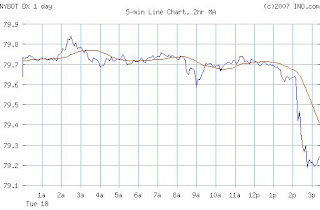
The dollar got hosed right after this announcement:
The Federal Open Market Committee decided today to lower its target for the federal funds rate 50 basis points to 4 3/4 percent.
Economic growth was moderate during the first half of the year, but the tightening of credit conditions has the potential to intensify the housing correction and to restrain economic growth more generally. Today's action is intended to help forestall some of the adverse effects on the broader economy that might otherwise arise from the disruptions in financial markets and to promote moderate growth over time.
Readings on core inflation have improved modestly this year. However, the Committee judges that some inflation risks remain, and it will continue to monitor inflation developments carefully.
Developments in financial markets since the Committee's last regular meeting have increased the uncertainty surrounding the economic outlook. The Committee will continue to assess the effects of these and other developments on economic prospects and will act as needed to foster price stability and sustainable economic growth.
Voting for the FOMC monetary policy action were: Ben S. Bernanke, Chairman; Timothy F. Geithner, Vice Chairman; Thomas M. Hoenig; Donald L. Kohn; Randall S. Kroszner; Frederic S. Mishkin; Charles L. Evans; William Poole; Eric S. Rosengren; and Kevin M. Warsh.
In a related action, the Board of Governors unanimously approved a 50 basis point decrease in the discount rate to 5 1/4 percent. In taking this action, the Board approved the requests submitted by the Boards of Directors of the Federal Reserve banks of Boston, New York, Cleveland, St. Louis, Minneapolis, Kansas City and San Francisco.
The dollar got hosed right after this announcement:

Monday, September 17, 2007
Another not so good omen:
Petroleos de Venezuela to Convert Accounts Away From Dollars
Petroleos de Venezuela to Convert Accounts Away From Dollars
By Steven Bodzin
Sept. 17 (Bloomberg) -- Venezuelan President Hugo Chavez instructed Petroleos de Venezuela SA, the state oil company, to convert its investment accounts from dollars to euros and Asian currencies to reduce risk.
The decision may help weaken the dollar as the Federal Reserve prepares to lower interest rates this week, said Philip Wee, an economist at DBS Bank Ltd. in Singapore. The currency has fallen against 14 of the 16 most-active over the past year, partly as governments signaled they may diversify their holdings away from the U.S., the world's primary destination for reserves.
Venezuela moved some of its reserves into euros last year, along with other oil producers including the United Arab Emirates, Kuwait and Qatar. The $50 billion Qatar Investment Authority said Sept. 4 it was looking for options in Asia to counter a weak dollar. China is starting a fund to look for higher returns on some of its almost $1.4 trillion holdings.
``Central banks will be switching more of the dollar into other currencies,'' said Wee, senior currency economist at DBS. ``This should be another negative in a trend that's already set in the interest-rate outlook'' and the Fed may lower borrowing costs to 4.75 percent by year-end from 5.25 percent, he said.
Chavez, speaking in his weekly address on national television yesterday, said the U.S. has bought goods from around the world, paying with paper that is ``a bubble.'' The president said he instructed Energy and Oil Minister Rafael Ramirez to change currencies after the Fed increased the U.S. money supply to alleviate a shortage of cash sparked by concerns about debt backed by sub-prime mortgages.
Iran, China
The dollar traded at $1.3883 per euro at 7:20 a.m. in London from $1.3875 late in New York on Sept. 14. It reached $1.3927 on Sept. 13, the lowest since the single European currency was introduced in 1999. The dollar may weaken to $1.40 per euro by year-end, Wee forecasts.
The world's oil trading system has primarily used dollars for decades. Iran in July requested yen rather than dollars for all shipments to Japan, boosting that currency.
Petroleos de Venezuela had $23 billion in current assets, including $1.88 billion in cash, $848 million in restricted cash and $9.55 billion in accounts receivable, at the end of 2006, according to its audited financial statement. In addition, the company finances the national development fund known as Fonden, which held $27.3 billion as of May 11.
Chavez speaks frequently about the need to increase his country's independence from the U.S., which he calls ``the empire.'' He has sought to diversify his country's customer base for oil by signing supply contracts with Japan and China.
Oil Minister Ramirez said Sept. 11 that Venezuela and China will work together on a $10 billion project to build six refineries and a shipping company to make Venezuela one of China's most important suppliers. Still, the U.S. continues to import 1.36 million barrels a day of crude and refined products from Venezuela, more than half its estimated 2.4 million barrels a day of output.
To contact the reporter on this story: Steven Bodzin in Caracas at sbodzin@bloomberg.net .
http://www.bloomberg.com/apps/news?p...cPI&refer=news
By Steven Bodzin
Sept. 17 (Bloomberg) -- Venezuelan President Hugo Chavez instructed Petroleos de Venezuela SA, the state oil company, to convert its investment accounts from dollars to euros and Asian currencies to reduce risk.
The decision may help weaken the dollar as the Federal Reserve prepares to lower interest rates this week, said Philip Wee, an economist at DBS Bank Ltd. in Singapore. The currency has fallen against 14 of the 16 most-active over the past year, partly as governments signaled they may diversify their holdings away from the U.S., the world's primary destination for reserves.
Venezuela moved some of its reserves into euros last year, along with other oil producers including the United Arab Emirates, Kuwait and Qatar. The $50 billion Qatar Investment Authority said Sept. 4 it was looking for options in Asia to counter a weak dollar. China is starting a fund to look for higher returns on some of its almost $1.4 trillion holdings.
``Central banks will be switching more of the dollar into other currencies,'' said Wee, senior currency economist at DBS. ``This should be another negative in a trend that's already set in the interest-rate outlook'' and the Fed may lower borrowing costs to 4.75 percent by year-end from 5.25 percent, he said.
Chavez, speaking in his weekly address on national television yesterday, said the U.S. has bought goods from around the world, paying with paper that is ``a bubble.'' The president said he instructed Energy and Oil Minister Rafael Ramirez to change currencies after the Fed increased the U.S. money supply to alleviate a shortage of cash sparked by concerns about debt backed by sub-prime mortgages.
Iran, China
The dollar traded at $1.3883 per euro at 7:20 a.m. in London from $1.3875 late in New York on Sept. 14. It reached $1.3927 on Sept. 13, the lowest since the single European currency was introduced in 1999. The dollar may weaken to $1.40 per euro by year-end, Wee forecasts.
The world's oil trading system has primarily used dollars for decades. Iran in July requested yen rather than dollars for all shipments to Japan, boosting that currency.
Petroleos de Venezuela had $23 billion in current assets, including $1.88 billion in cash, $848 million in restricted cash and $9.55 billion in accounts receivable, at the end of 2006, according to its audited financial statement. In addition, the company finances the national development fund known as Fonden, which held $27.3 billion as of May 11.
Chavez speaks frequently about the need to increase his country's independence from the U.S., which he calls ``the empire.'' He has sought to diversify his country's customer base for oil by signing supply contracts with Japan and China.
Oil Minister Ramirez said Sept. 11 that Venezuela and China will work together on a $10 billion project to build six refineries and a shipping company to make Venezuela one of China's most important suppliers. Still, the U.S. continues to import 1.36 million barrels a day of crude and refined products from Venezuela, more than half its estimated 2.4 million barrels a day of output.
To contact the reporter on this story: Steven Bodzin in Caracas at sbodzin@bloomberg.net .
http://www.bloomberg.com/apps/news?p...cPI&refer=news
Sunday, September 16, 2007
From
September 16, 2007
Alan Greenspan claims Iraq war was really for oil
AMERICA’s elder statesman of finance, Alan Greenspan, has shaken the White House by declaring that the prime motive for the war in Iraq was oil.
In his long-awaited memoir, to be published tomorrow, Greenspan, a Republican whose 18-year tenure as head of the US Federal Reserve was widely admired, will also deliver a stinging critique of President George W Bush’s economic policies.
However, it is his view on the motive for the 2003 Iraq invasion that is likely to provoke the most controversy. “I am saddened that it is politically inconvenient to acknowledge what everyone knows: the Iraq war is largely about oil,” he says.
Greenspan, 81, is understood to believe that Saddam Hussein posed a threat to the security of oil supplies in the Middle East.
Britain and America have always insisted the war had nothing to do with oil. Bush said the aim was to disarm Iraq of weapons of mass destruction and end Saddam’s support for terrorism.
Gates rejects Greenspan claim war is about oil
By Thomas Ferraro 1 hour, 29 minutes ago
WASHINGTON (Reuters) - U.S. Defense Secretary Robert Gates on Sunday rejected former Federal Reserve Chairman Alan Greenspan's statement that the Iraq war "is largely about oil."
With Democratic lawmakers apparently short of the votes needed to force President George W. Bush to change course, Gates defended the war, now in its fifth year, and said it's being driven by the need to stabilize the Gulf and put down hostile forces.
Gates's defense came a day after thousands of anti-war protesters marched in Washington. A spokeswoman for one of the groups who organized the march said more than 200 protesters were taken into custody, including at least 10 Iraq war veterans, when they attempted to cross a police barrier near the U.S. Capitol.
Greenspan, in his new book, "The Age of Turbulence: Adventures in a New World," echoed long-held complaints of many critics that a key motivating force in the war is to maintain U.S. access to the rich oil supplies in Iraq.
"Whatever their publicized angst over Saddam Hussein's 'weapons of mass destruction,' American and British authorities were also concerned about violence in an area that harbors a resource indispensable for the functioning of the world economy," Greenspan wrote.
"I'm saddened that it is politically inconvenient to acknowledge what everyone knows: The Iraq war is largely about oil," added Greenspan, who for decades had been one of the most respected U.S. voices on fiscal policies.
After more than 18 years at the helm, Greenspan retired in January 2006 as chairman of the Fed, the nation's central bank, which regulates monetary policy.
Appearing on ABC's "This Week," Gates said, "I have a lot of respect for Mr. Greenspan." But he disagreed with his comment about oil being a leading motivating factor in the war.
"I wasn't here for the decision-making process that initiated it, that started the war," Gates said. But he added, "I know the same allegation was made about the Gulf War in 1991, and I just don't believe it's true."
"I think that it's really about stability in the Gulf. It's about rogue regimes trying to develop weapons of mass destruction. It's about aggressive dictators," Gates said.
"After all, Saddam Hussein launched wars against several of his neighbors," Gates said. "He was trying to develop weapons of mass destruction, certainly when we went in, in 1991."
Bush last week ordered gradual troop reductions in Iraq into next summer but defied calls for a dramatic change of course, saying the U.S. military role there will stretch beyond his presidency.
Gates said he would urge Bush to veto a proposal by Democratic Sen. James Webb of Virginia that would require U.S. troops spend as much time at home as their previous tour in Iraq.
"It would be extremely difficult for us to manage that," Gates said. "It really is a backdoor way to try and force the president to accelerate the drawdowns. Again, the drawdowns have to be based on the conditions on the ground."
Senate Armed Services Committee Chairman Carl Levin, a Michigan Democrat, said he did not know if the Senate, held by Democrats, 51-49, would be able to muster the 60 votes needed to clear a Republican procedural roadblock and approve the Webb measure. But he said "it has a good chance."
He conceded, however, that at this point backers do not have the two-thirds majority that would be needed to override a Bush veto of the legislation.
"But that doesn't mean we shouldn't fight for what we believe in just because the president may veto it," Levin said on CBS's "Face the Nation."
"I think there's enough Republicans who believe we've got to change course but whether they'll vote that way, we just simply don't know," Levin said.
(Additional reporting by David Wiessler, Mark Felsenthal and Doug Palmer)
Thursday, September 13, 2007
A pub turns into club
McKinney: The Londoner got around loss of alcohol license12:00 AM CDT on Thursday, September 13, 2007
McKINNEY – Order and purpose have returned to 100 N. Tennessee St. All again goes with the flow.


REX C. CURRY/Special Contributor
An outpouring of public support helped the Londoner become a private club, where patrons must be members. For as the banner flying Tuesday over McKinney put it: "The Londoner Is Open!!"
Three months after losing its state license to sell alcoholic beverages, the popular pub is back as a private club – with a little help from some friends.
Since its opening four-plus years ago, the place has become a gathering spot and energy hub for downtown McKinney, creating some night life and, as alcohol sources can do, occasionally some work for police.
It has drawn a loyal following (as well as a Guinness and more) with its fish and chips, dartboards, jukebox and mother-country public house look and feel.
"You walk in here a stranger, and by the end of the night you've got a roomful of friends," said Lucy Parker Watkins, a regular who often brings her two daughters in for meals and playful company.
And in recent months, an outpouring of public support has helped the pub through dry and uncertain times.
In May 2004, McKinney voters decided restaurants could sell mixed drinks and other alcoholic beverages, as long as alcohol sales provide no more than half of their revenue.
But in June, the Texas Alcoholic Beverage Commission declined to renew the Londoner's mixed-drink permit after the business attributed 61 percent of its previous year's revenue to alcohol.
Facing a yearlong wait to reapply for the permit, the pub's owner applied to sell alcohol as a private club.
For a spell, the restaurant gave away beer and wine to keep its spirit alive – a short-lived offer that became too popular and costly. Loyalists' appetites and tips helped keep the doors open, as did profits from the Londoner's sister pub in Addison. Some employees hung in with pay cuts.
And when the city staff opposed the Londoner's private club plan, its die-hards responded with signs, petitions and words of support to the City Council.
Besides a state license, McKinney also requires that private clubs obtain a council-approved specific-use permit.
The city planning staff recommended denial of the Londoner's permit because of "general concern over the number and severity of police calls" there, said Melissa Henderson, city planning director.
Since 2005, McKinney police have responded to 10 alcohol-related disturbances inside or near the Londoner, including five cases of public intoxication and three fights, said Capt. Randy Roland, a police spokesman.
"It's the type of calls we were seeing that caused concern," he said, explaining why Police Chief Doug Kowalski proposed denial of the permit.
"They were acting like a bar. That's why they lost their state license," Capt. Roland said. "Our attempt was to raise the red flag. ... The chief said we'd rather not have bars, but if you want them, we'll police them."
Any problem or police call is unfortunate, said Barry Tate, the Londoner's Texas-born, England-bred general manager. But trouble can happen wherever alcohol is served, he said, particularly after 9 p.m.
"You can't watch everyone," he said. Still, 10 disturbances in going on three years are, relatively speaking, "nothing," he said.
As the Londoner's request came to a head, about 750 people signed a petition supporting it. Some posted storefront signs or praised the Londoner before the council and its advisory planning and zoning commission.
And after the council's unanimous OK on Sept. 4, adult beverages returned to the two-story brick building, circa 1890, at the southeast corner of the square.
"We can't thank them enough for what they've done," Marie Briton, the Londoner's manager, said of the pub's champions, who won't see much change in the revived operation.
State law requires that a private club's patrons be members of the establishment. But the serving of alcoholic beverages is otherwise no different than at other types of bars or restaurants. And the city permit now requires that the Londoner derive at least 35 percent of its revenues from food sales.
"We just have to scan the driver's license and they are a member for a year," said Ms. Briton, who, like her boss, is a transplant from England.
Mayor Bill Whitfield said he welcomed the Londoner's public show of support but added that the council probably would have supported the pub anyway.
"I don't think the picture is as bad" as presented, the mayor said, of the police department's concerns.
The Londoner "serves a purpose," he said, in helping enliven a city core that has been rich in antique, clothing and knickknack shops – but now includes a broadening array of restaurants and 12 businesses selling alcoholic beverages.
"It's a meeting place, a place you know you can find people," said Gerhard Deffner, a downtown resident who pulled the Londoner banner behind his airplane this week.
Several downtown merchants said worries about fights and drunks are overblown.
"There is no bar atmosphere" downtown, said Brian Keffer, manager of Landon Winery at the southwest corner of the square.
"They are bringing in diversity," he said of the Londoner. "The city should approve."

Wednesday, September 12, 2007
Oil hits record $80 on tight supply
Wed Sep 12, 2007 2:14 PM EDT
(Page 1 of 2)
By Richard Valdmanis
NEW YORK (Reuters) - Crude oil prices vaulted to a record high $80 a barrel on Wednesday as dealers focused on tight inventories in top consumer the United States ahead of peak winter demand.
A rash of fires at BP's oil fields in Alaska's North Slope added to the record run, though BP said the accidents had minimal impact to production that was already being curtailed by routine maintenance.
The surge in oil prices came a day after OPEC agreed to a small production hike in an effort to soothe consumer nations' fears that soaring crude costs could slow economic growth.
"The OPEC outcome was not enough of a shocker to turn around a market that likes to read extremes," said Olivier Jakob of oil consultancy Petromatrix.
U.S. light crude for October delivery was up $1.59 at $79.82 per barrel at 2:07 p.m. EDT after setting a record high of $80.00 a barrel earlier. London Brent crude was up $1.35 at $77.73 a barrel.
Crude oil stocks in top consumer the United States fell 7.1 million barrels last week to their lowest level in eight months ahead of the winter heating season, according to the U.S. Energy Information Administration.
Analysts had expected a fall of 2.4 million barrels.
"The reality is that the crude tightness in Europe and Asia has begun to affect the U.S. market in a big way," said Antoine Halff, analyst at Fimat Research in New York. "In retrospect, it validates OPEC's decision to increase production."
Heating oil futures prices also struck a record Wednesday of $2.2139 a gallon, up 3.12 cents.
Experts said OPEC's deal in Vienna Tuesday to raise output by a half a million barrels per day starting November 1 was not enough to reverse rising energy prices.
"It legitimises the excess production that was there relative to OPEC's previous implied quota and not much more," said Harry Tchilinguirian, senior oil market analyst at BNP Paribas. Continued ...
http://ca.today.reuters.com/news/new...archived=False
Wed Sep 12, 2007 2:14 PM EDT
(Page 1 of 2)
By Richard Valdmanis
NEW YORK (Reuters) - Crude oil prices vaulted to a record high $80 a barrel on Wednesday as dealers focused on tight inventories in top consumer the United States ahead of peak winter demand.
A rash of fires at BP's oil fields in Alaska's North Slope added to the record run, though BP said the accidents had minimal impact to production that was already being curtailed by routine maintenance.
The surge in oil prices came a day after OPEC agreed to a small production hike in an effort to soothe consumer nations' fears that soaring crude costs could slow economic growth.
"The OPEC outcome was not enough of a shocker to turn around a market that likes to read extremes," said Olivier Jakob of oil consultancy Petromatrix.
U.S. light crude for October delivery was up $1.59 at $79.82 per barrel at 2:07 p.m. EDT after setting a record high of $80.00 a barrel earlier. London Brent crude was up $1.35 at $77.73 a barrel.
Crude oil stocks in top consumer the United States fell 7.1 million barrels last week to their lowest level in eight months ahead of the winter heating season, according to the U.S. Energy Information Administration.
Analysts had expected a fall of 2.4 million barrels.
"The reality is that the crude tightness in Europe and Asia has begun to affect the U.S. market in a big way," said Antoine Halff, analyst at Fimat Research in New York. "In retrospect, it validates OPEC's decision to increase production."
Heating oil futures prices also struck a record Wednesday of $2.2139 a gallon, up 3.12 cents.
Experts said OPEC's deal in Vienna Tuesday to raise output by a half a million barrels per day starting November 1 was not enough to reverse rising energy prices.
"It legitimises the excess production that was there relative to OPEC's previous implied quota and not much more," said Harry Tchilinguirian, senior oil market analyst at BNP Paribas. Continued ...
http://ca.today.reuters.com/news/new...archived=False
Subscribe to:
Posts (Atom)