The Fed Has Wrecked the Stock Market
by Mike Whitney
America is finished, washed up, kaput. Foreign investors and central banks around the world have lost confidence in US markets and are headed for the exits. The dollar is sinking, the country is insolvent, and its leaders are barking mad. Investors are voting with their feet. They've had enough. Capital is flowing to China and the Far East in a torrent. It's "sayonara" downtown Manhattan and "Hello" Tiananmen Square.
The dollar fell another 2 per cent last night, gold soared to $840 per ounce, oil topped $98 per barrel, General Motors reported a $39 billion loss after the market closed on Tuesday, the real estate market continued its downward slide, and the major investment banks are marching in lock-step towards bankruptcy.
The news is all bad. The nation's economic foundation is in shambles. US credibility is shot. Bush and Greenspan have put us on the road to ruin. Now their work is done. We're flat broke.
The catalogue of fiscal ailments now facing the country is too long to list. We'd need a ledger the size of a small encyclopedia. There's been a stampede away from the dollar even though it's already lost over 60 per cent of its value since Bush took office and even though central banks around the world will lose their shirts if it collapses. They don't care. They're getting out while they can.
Cheng Siwei, the vice chairman of China's National People's Congress, announced yesterday that China would continue to diversify its $1.4 trillion reserves away from the dollar to "stronger currencies" like the euro. "Strong currencies"; isn't that Paulson's line? Siwei's comments ignited a firestorm in the currency markets triggering a big blow-off of the greenback. The poor dollar has no place to go now but down, and it's on a greased pole to the bottom. With consumer spending paralyzed by the decline in home equity and frozen wages, and the banks "stuffed to the gills" with over a trillion dollars of mortgage-backed sludge; the prognosis for the hobbled dollar is looking grimmer by the day. The bulging trade deficits and dwindling foreign inflows haven't helped either. The greenback has suddenly become the global pariah; all it needs is a leper's rattle and a tin cup.
The news is no better in the real estate industry either, where the nation's biggest builders are reporting record losses and inventory is backed up 11 months. Sales are off 22 per cent in one year alone. Foreclosures are skyrocketing, jumbo loans (over $417,000) are impossible to get regardless of one's credit history, 40 per cent of all mortgages (subprime, Alt-A, piggyback, reverse amortization, interest-only) have been eliminated, and entire projects in Florida, Arizona, Las Vegas, and California's Central Valley have stopped building altogether. Tens of thousands of unoccupied homes across the Southwest have been reduced to ghost towns. Nothing is selling. The building boom, that began when Alan Greenspan ginned-up the Fed's printing presses in 2002, has turned into the biggest housing bust in American history.
On top of that, the banks are tightening lending standards and shunning potential buyers just when the economy needs a boost in demand. Loan originations are down and bankers are spooked by the gathering storm in the credit markets. That means that home sales will continue to be sluggish, prices will correct more quickly, and the anticipated "soft landing" will turn into a full-blown crash.
New home construction has accounted for 2 out of every 5 new jobs created in the last 5 years. Most of those workers are either delivering pizzas, cleaning bed pans or are lining up at the soup kitchen. The BLS's numbers on employment are bogus. It's just more government bunkum. They're predicated on a "birth-death" model that creates millions of fictitious jobs out of whole cloth. In truth, unemployment is soaring and the most vulnerable and impoverished among us are taking a beating from the housing debacle.
According to the Mortgage Bankers Association of Washington, the total of mortgage loans outstanding in 2006 was $10.9 trillion; $6 trillion of which were transformed into securities (CDOs, MBSs) About $1.5 trillion of those securities are subprime; another $1 trillion Alt-A (nearly as risky) and at least another $1.5 trillion in adjustable rate mortgages (ARMs). At least 20 per cent of these shaky liabilities/securities will default, and yet, no one really knows who is holding them on their books. All of the major financial institutions – the insurance companies, foreign banks, hedge funds, investment banks – have purchased these CDO "roadside bombs" and mixed them in with their other performing loans and hard assets. The projected explosions have already begun to take their toll on the financial giants – Citigroup and Merrill Lynch are just the latest victims; others will follow. The problem can't be fixed with Bernanke's low interest rates. The bad debts are everywhere and must accounted for and written down. That puts us on the threshold of a jarring market-downturn triggered by an unprecedented number of defaults that will rumble through the entire system. Bankruptcies will pop up everywhere at random. It is a blueprint for economic chaos. And it is unavoidable.
The global markets have never seen a financial typhoon of this magnitude before. Mortgage lenders, homeowners, banks, hedge funds, bond insurers, etc. will all either go under or feel the sting of a slumping market.
Many of the major investment banks are already broke; it's clear from their own reporting. Charles Hugh Smith sums it up like this in his recent article "Empire of Debt: The Great Unraveling":
"If their bad bets were marked to market, Citicorp and Merrill Lynch would be declared insolvent. Why? Because they are insolvent – right now. The meaning of insolvency is straightforward: their losses exceed their capital. Recall that these firms list assets of $100 billion (or whatever) but their actual net capital is on the order of 2.5 per cent to 5 per cent – a mere sliver of their stated assets. In other words: a 5 per cent loss of their stated assets wipes them out. The game is now over, and the players shuffling losses can only last a few more days or weeks."
Up to this point, the banks have been able to place a sizeable portion of their "hard-to-value" assets in a Level-3 grab bag, which allowed company accountants to assign a value to those assets according to their own judgment. No more. The new FASB 157 regulation will force the banks to use "market prices" to determine the true value of their holdings. Some analysts believe that these new disclosure rules may result in $200 billion write-downs on assets and require the over-leveraged banks to increase their capital reserves. That will slow down lending and put a wrinkle in the banks' bottom line. In any event, once the law is enacted; we'll see who's "faking" the value of their assets or as Warren Buffett says, "Who's swimming with their clothes off.
Professor Nouriel Roubini summed it up like this:
"The amount of losses that financial institutions have already recognized – $20 billion – is just the very tip of the iceberg of much larger losses that will end up in the hundreds of billions of dollars. Calling this crisis a sub-prime meltdown is ludicrous as by now the contagion has seriously spread to near prime and prime mortgages. And it is spreading to every corner of the securitized financial system that is either frozen or on the way to freeze. The reality is that most financial institutions have barely started to recognize the lower "fair value" of their impaired securities. The credit crunch is getting worse and its financial and real fallout will be severe." (Nouriel Roubini blog.)
The constant drumbeat of bad news is having a numbing affect on Wall Street. Traders' are tight-lipped and downcast. Spirits are sagging. No one likes losing money, and yet, the credit storm shows no signs of letting up anytime soon. Yesterday, the Dow Jones Industrial's took another 360-point pounding before the bell rang. Another day, another bloodbath. The subprime virus has now infected the broader markets leaving the once-brawny financial giants bruised and reeling like Joe Frazier in the Thrilla in Manila. A few more down-days like yesterday and they'll be carrying out hedge funds feet first.
The stock market is looking more and more like a glass pitcher propped up on the edge of a bookshelf. One little bump, and down she goes.
November 10, 2007
http://www.lewrockwell.com/orig8/whitney2.html

Tuesday, November 06, 2007

McKinney, Texas – November 7, 2007
Second Annual ”Los Dias de los Muertos” Celebration at
Carrie Garner’s Galleria d’Arte
Carrie Garner’s Galleria d’Arte
Los Dias de los Muertos, the traditional Mexican holiday of remembering and honoring the dead, will once again be celebrated at Carrie Garner’s Galleria d’ Arte, located at 115 South Kentucky Street in downtown McKinney. You are invited to join the artists’ reception from 7pm to 10pm, this Saturday, November 10, 2007.
Gallery friend and artist extraordinaire, Kimm Lanus returns with her newest “Katrina Series” paintings along with her newest spiritual-inspired works of art. Ms. Lanus’ paintings are crafted on tin, wood, canvas, and paper in the old retablos and Italian style of painting. All pieces are sealed for longevity, and each piece is framed in the time-honored gothic European tradition. Lanus’ collectors include former ABC anchorman, Sam Donaldson and President George W. Bush.
Frida Kahlo, another of Lanus’ favorite subjects, will also be debuted at the reception. Bold colors and captivating themes abound in each and every Lanus creation.
Galleria d’Arte is pleased to welcome photographer Donald Scharf. Photographs from his body of work, “Lugares y Encuentros” are the perfect complement to Lanus’ paintings. “Photo images are magic. They tell a story. If the viewer stops and examines…then ….. there is the beginning of a connection to the image, “ says Scharf.
Live Latin music on our patio will round out the evening’s celebration. Co-sponsors of the event are A Twist of Lime, BLING!, Cadillac Pizza Pub, MeSo Lounge, and Poppy’s Garden Café.
MeSo Lounge is now open on the first floor at Galleria d’Arte. Specializing in boutique wines and premium beers, MeSo is certain to become a favorite downtown destination. The lounge offers a daily selection of appetizers, cheeses, and antipastos. Sip some wine, nibble on appetizers, and stroll around the three art galleries of the Old Collin County Prison.
MeSo’s comfortable and hip atmosphere is the perfect complement to the three art galleries of the old Collin County prison. Carrie Garner’s Galleria d’Arte, Studio Duende, and Aristeia Gallery all feature works of art by local and regional artists.


FOUR ACCOMPLISHED ARTISTS FEATURED IN NOVEMBER
McKinney, TX – Aristeia Gallery is delighted to feature noted portrait artist, DeDe Barr and three of her very talented students for the November Second Saturday event. Patricia Hanszen, Tawni Hodge and Lois Nightingale are all accomplished artists in their own right, and share a commonality of being long-time art students of Ms. Barr.
DeDe Barr, a former McKinney resident, now living in Dallas, has distinguished herself as a much sought after portrait artist, among whose clients include former presidents,
U. S. senators, ambassadors and foreign dignitaries as well as noted sports figures. In addition to oil portraits, Ms. Barr creates portraits in graphite and has illustrated children’s books. Among Ms. Barr’s most recognized pieces are the official portraits of former president, Lyndon B. Johnson and that of Dallas’ own, Audie Murphy, America’s most decorated WWII hero.
On Saturday evening, Ms. Barr will have sample commission portraits and some of her current works on display at the gallery and she will be on-hand to greet guests and answer questions regarding her work.
Although Dallas native, Patricia Hanszen, pursued a career in business she always pursued her love of art through independent study and exposure to the influences of the country’s finest artists. While living in Boston and New York, Patricia’s love of realism developed and her subjects ranged from still life and florals to capturing the beauty of New England’s landscapes.
Patricia says that her strong influences in art have been Richard Schmid, impressionist, John Asaro and she remains a great admirer of John Singer Sargent. Patricia says that “beautiful art touches something much deeper within me” and she is now painting full-time while continuing to study under various well-known artists including DeDe Barr.
Growing up in Allen, TX, Tawni Hodge attended Baylor University, UNT and Texas Women’s University, where she received a degree in Fashion Design with a minor in Fine Art. It appears she was destined to be an artist, as she began her career in the fashion industry and her current career is in interior design, owning and operating a free-lance design business in Sherman. Tawni says that “through clothing and bare interiors”, she has been “painting for years with fabrics and furniture.” Several years ago she discovered a group of artists, taught by DeDe Barr and was inspired to pick up a brush and paint on canvas, Tawni says that “DeDe has given me the direction and skill and my fellow students have made the journey joyful.” Tawni photographs her own references for her paintings, including those for portrait commissions.
Prior to moving to the Dallas in 2001, Lois Nightingale enjoyed a successful career as an Art Director and Designer in the Washington, DC area. Lois says that she has “always been drawn to the decorative arts, fine art and portraiture”. With her husband’s transfer to Dallas in 2001, Lois was afforded her the opportunity to pursue her desire to paint.
Several years ago Ms. Nightingale began studying oil portraiture with DeDe Barr. A memorable part of this study included an extended visit to Italy in October of last year. She continues her study with DeDe and is accepting commissions for portraits. Lois and her husband have a successful manufacturing business in Ennis, TX.

Thursday, November 01, 2007

Tuesday, October 30, 2007

“Prisoners of Love Monster Bash”
Do you have the courage to spend Halloween evening in a haunted prison? Are you adventuresome enough to have lots of fun, and to celebrate Halloween with some characters and spirits?
The art galleries of The Old Collin County Prison are hosting the 2007 Halloween event of the year, benefiting the Love Life Foundation (www.lovelifefoundaton.com). Be sure to plan to spend the evening with us. There is no better place to hang out on Halloween than the Prisoner’s of Love Monster Bash at the old Collin County prison, 115 S. Kentucky Street in downtown McKinney .
Costumes are preferred, of course, but all are welcome. Come howl at the moon, celebrate community and have an impressively good time, while raising money for
at-risk children of Collin County.
The evening’s events will be highlighted with a live performance by The Maylee Thomas Band. Maylee is guaranteed to move your spirit and shake your soul as she entertains you in her high-energy style and her strong, “hauntingly” beautiful voice.
An auction featuring items by local merchants and regional artists will be the best trick-or-treat you’ll get all evening. One-of-a kind works of art and valuable gifts will fill up your goody bag before the night is over. Contests, games, and tequila tasting will keep your spirits high and the place jumping all night long.
Do you know the story of Ezel Stepp and some of the other infamous “guests” of the old Collin County prison? Learn about Mr. Stepp’s fateful walk into Collin County history. You may even met “Lovely Lily,” the resident ghost of 115 S. Kentucky Street , who makes her presence known on a daily basis.
Have a blast, raise money for charity and satisfy the thrill-seeker and fun-lover in you. Celebrate Halloween, 2007 at Prisoners of Love Monster Bash…if you dare.
Sunday, October 28, 2007
How cool is this? Today I received the neatest email I have gotten in a long time! Kudos to Mary Beth!!!

Mary Beth Schad of EllieandOllie.com and her husband Jim
Martha Stewart's Dreamers into Doers
"We can finally talk about it! Back in June, Ellie&Ollie entered the Dreamers into Doers contest found in Martha Stewart's Living magazine. In August, the phone rang and it was someone notifying us that we had been chosen as one of the 11 finalists in the contest! Needless to say, my jaw dropped, yet I couldn't stop smiling and of course I wanted to tell EVERYONE! However, the rules requested that we keep this little secret to ourselves until the end of October. This was going to be a long two months...
In October, my husband and I were flown to New York City. We were treated like royalty from the moment we stepped off of the plane. Between Talbots outfitting the finalists, Bank of America matching our prize money, attending the TV show, being honored at a formal Gala, meeting Carole King, seeing her perform, and our amazing accommodations, we weren't sure life could get much better. Everyone was so gracious and congratulatory to all of us. We had to stop and thank THEM from time to time as they were the ones who had selected the winners, and they were the ones who were honoring all of us. New York is truly a great city. I have a new spot in my heart for it, it's culture, and it's people.
Speaking of people....up to the moment we arrived in NYC we were excited for ourselves and what we were experiencing. It dawned on us that we were going to meet 10-20 other people who had been chosen just like us, and we knew each of them would have a unique story as well. It is so easy to get caught up in your own self-importance and daily routine that it's easy to develop a myopic view of the world. But, when you are surrounded by the types of people we were with, it humbles and inspires you. We cried over some of the stories we heard, laughed at others, learned some things along the way, and made some new friends. I've told each of them I was coming to visit....so I hope they are ready! Each of these women was inspirational and passionate towards their businesses, causes and their lives in general. There are wonderful people in this world, and it was so nice to meet a whole group of them!
Finally, we would like to thank Martha Stewart and all of her staff who worked so hard to pull the entire week together. We would also like to thank Talbot's for the beautiful (and free!) clothes as well as Bank of America for their generous contributions. Without all of their combined efforts and support, none of this would have been possible.
Ellie&Ollie will do it's best to make you proud you chose us as a finalist."
Go support these folks! Cookies are great!
http://www.ellieandollie.com

Mary Beth Schad of EllieandOllie.com and her husband Jim
Martha Stewart's Dreamers into Doers
"We can finally talk about it! Back in June, Ellie&Ollie entered the Dreamers into Doers contest found in Martha Stewart's Living magazine. In August, the phone rang and it was someone notifying us that we had been chosen as one of the 11 finalists in the contest! Needless to say, my jaw dropped, yet I couldn't stop smiling and of course I wanted to tell EVERYONE! However, the rules requested that we keep this little secret to ourselves until the end of October. This was going to be a long two months...
In October, my husband and I were flown to New York City. We were treated like royalty from the moment we stepped off of the plane. Between Talbots outfitting the finalists, Bank of America matching our prize money, attending the TV show, being honored at a formal Gala, meeting Carole King, seeing her perform, and our amazing accommodations, we weren't sure life could get much better. Everyone was so gracious and congratulatory to all of us. We had to stop and thank THEM from time to time as they were the ones who had selected the winners, and they were the ones who were honoring all of us. New York is truly a great city. I have a new spot in my heart for it, it's culture, and it's people.
Speaking of people....up to the moment we arrived in NYC we were excited for ourselves and what we were experiencing. It dawned on us that we were going to meet 10-20 other people who had been chosen just like us, and we knew each of them would have a unique story as well. It is so easy to get caught up in your own self-importance and daily routine that it's easy to develop a myopic view of the world. But, when you are surrounded by the types of people we were with, it humbles and inspires you. We cried over some of the stories we heard, laughed at others, learned some things along the way, and made some new friends. I've told each of them I was coming to visit....so I hope they are ready! Each of these women was inspirational and passionate towards their businesses, causes and their lives in general. There are wonderful people in this world, and it was so nice to meet a whole group of them!
Finally, we would like to thank Martha Stewart and all of her staff who worked so hard to pull the entire week together. We would also like to thank Talbot's for the beautiful (and free!) clothes as well as Bank of America for their generous contributions. Without all of their combined efforts and support, none of this would have been possible.
Ellie&Ollie will do it's best to make you proud you chose us as a finalist."
Go support these folks! Cookies are great!
http://www.ellieandollie.com
Saturday, October 27, 2007
From Bill Fleckenstein of Fleckenstein Capital this week!
Barf went the Merrill bull
It's a lesson that hit Merrill Lynch (MER, news, msgs) hard. Witness the subprime fallout behind the company's sobering third-quarter earnings report. Merrill wrote down about $5.8 billion of $14.2 billion in what's known as super-senior subprime assets -- the stuff that's supposedly above AAA and bulletproof.When asked on the conference call if everything was marked where it could be sold, there was no answer, leaving folks with the idea that there was plenty of stuff still marked to model. And you can be sure that if Merrill Lynch has this problem of potentially mismarked paper, so do all of the brokers and probably some of the big banks. This is a huge deal. (Memo to nonbelievers: The problem is spreading, it has not been discounted and it has not been contained.)
Thursday, October 25, 2007

September Truck Tonnage Declines 2.3%, ATA Says
September Truck Tonnage Declines 2.3%, ATA Says
American Trucking Associations’ seasonally adjusted for-hire truck tonnage index for September declined 2.3% from a year ago, ATA said late Thursday.
The downturn followed a 0.9% year-over-year gain in August, and the September index was up 1.5% measured from the previous month, ATA said.
The index’s reading was 111.6. Year to date, the truck tonnage index was 2.2% lower than the same time last year.
The not seasonally adjusted index fell 10.6% from August, to 107.4, ATA said.
ATA Chief Economist Bob Costello said the reading points to continued softness in the trucking industry, despite the month-to-month increase. Although the 1.5% gain was the biggest monthly increase since February, Costello noted that he expects tonnage to remain choppy in the foreseeable future, a trend that began several months ago.
“Nearly all economic indicators suggest continued sluggishness for the trucking industry in the near term,” Costello said. “September’s reading points to a lackluster 2007 fall freight season, which traditionally starts in mid- to late August and peaks in October. We are sticking with our economic forecasts that point to below trend growth for the overall economy and truck tonnage.”
ATA calculates the tonnage each month based on reports by its member trucking companies.
________________________________________________________
And on a related note:
The OPEC Sec General stated that OPEC members are free to sell oil in currency other than dollars; Iran and Venezuela already do.
American Trucking Associations’ seasonally adjusted for-hire truck tonnage index for September declined 2.3% from a year ago, ATA said late Thursday.
The downturn followed a 0.9% year-over-year gain in August, and the September index was up 1.5% measured from the previous month, ATA said.
The index’s reading was 111.6. Year to date, the truck tonnage index was 2.2% lower than the same time last year.
The not seasonally adjusted index fell 10.6% from August, to 107.4, ATA said.
ATA Chief Economist Bob Costello said the reading points to continued softness in the trucking industry, despite the month-to-month increase. Although the 1.5% gain was the biggest monthly increase since February, Costello noted that he expects tonnage to remain choppy in the foreseeable future, a trend that began several months ago.
“Nearly all economic indicators suggest continued sluggishness for the trucking industry in the near term,” Costello said. “September’s reading points to a lackluster 2007 fall freight season, which traditionally starts in mid- to late August and peaks in October. We are sticking with our economic forecasts that point to below trend growth for the overall economy and truck tonnage.”
ATA calculates the tonnage each month based on reports by its member trucking companies.
________________________________________________________
And on a related note:
The OPEC Sec General stated that OPEC members are free to sell oil in currency other than dollars; Iran and Venezuela already do.
Tuesday, October 23, 2007
Living paycheck to paycheck gets harder
By ANNE D'INNOCENZIO
AP Business Writer
AP Photo/Bebeto Matthews
NEW YORK (AP) -- The calculus of living paycheck to paycheck in America is getting harder. What used to last four days might last half that long now. Pay the gas bill, but skip breakfast. Eat less for lunch so the kids can have a healthy dinner.
Across the nation, Americans are increasingly unable to stretch their dollars to the next payday as they juggle higher rent, food and energy bills. It's starting to affect middle-income working families as well as the poor, and has reached the point of affecting day-to-day calculations of merchants like Wal-Mart Stores Inc., 7-Eleven Inc. and Family Dollar Stores Inc.
Food pantries, which distribute foodstuffs to the needy, are reporting severe shortages and reduced government funding at the very time that they are seeing a surge of new people seeking their help.
While economists debate whether the country is headed for a recession, some say the financial stress is already the worst since the last downturn at the start of this decade.
From Family Dollar to Wal-Mart, merchants have adjusted their product mix and pricing accordingly. Sales data show a marked and more prolonged drop in spending in the days before shoppers get their paychecks, when they buy only the barest essentials before splurging around payday.
"It's pretty pronounced," said Kiley Rawlins, a spokeswoman at Family Dollar. "It seems like to us, customers are running out of food products, paper towels sooner in the month."
Wal-Mart, the world's largest retailer, said the imbalance in spending before and after payday in July was the biggest it has ever seen, though the drop-off wasn't as steep in August.
By ANNE D'INNOCENZIO
AP Business Writer
AP Photo/Bebeto Matthews
NEW YORK (AP) -- The calculus of living paycheck to paycheck in America is getting harder. What used to last four days might last half that long now. Pay the gas bill, but skip breakfast. Eat less for lunch so the kids can have a healthy dinner.
Across the nation, Americans are increasingly unable to stretch their dollars to the next payday as they juggle higher rent, food and energy bills. It's starting to affect middle-income working families as well as the poor, and has reached the point of affecting day-to-day calculations of merchants like Wal-Mart Stores Inc., 7-Eleven Inc. and Family Dollar Stores Inc.
Food pantries, which distribute foodstuffs to the needy, are reporting severe shortages and reduced government funding at the very time that they are seeing a surge of new people seeking their help.
While economists debate whether the country is headed for a recession, some say the financial stress is already the worst since the last downturn at the start of this decade.
From Family Dollar to Wal-Mart, merchants have adjusted their product mix and pricing accordingly. Sales data show a marked and more prolonged drop in spending in the days before shoppers get their paychecks, when they buy only the barest essentials before splurging around payday.
"It's pretty pronounced," said Kiley Rawlins, a spokeswoman at Family Dollar. "It seems like to us, customers are running out of food products, paper towels sooner in the month."
Wal-Mart, the world's largest retailer, said the imbalance in spending before and after payday in July was the biggest it has ever seen, though the drop-off wasn't as steep in August.
Monday, October 22, 2007
This would seem to have some bearing on things...
http://www.breitbart.com/article.php?id=071022154152.yz1uni1....
IMF chief warns dollar may suffer 'abrupt fall'
The head of the International Monetary Fund, Rodrigo Rato, warned Monday there are risks of an "abrupt fall" in the dollar, linked to a loss of confidence in dollar assets.
"There are risks that an abrupt fall in the dollar could either be triggered by, or itself trigger, a loss of confidence in dollar assets," Rato told the IMF board of governors.
He also appeared to suggest that Europe could take steps to temper the strong appreciation of the euro.
"There is a risk that exchange rate appreciation in countries with flexible exchange rates -- including the euro area -- could hurt their growth prospects, and that in these circumstances protectionist pressures could worsen," he said on the final day of the annual meetings of the IMF and the World Bank.
The outgoing IMF managing director spoke as the European single currency hit a new high of 1.4347 dollars and global equity markets tumbled amid growing fears a US housing-related credit crunch could pitch the world's biggest economy into recession.
"The uncertainty ... comes from downside risks that are much higher than they were six months ago. The turbulence in the credit markets is a warning that we cannot take the benign economic environment of recent years for granted," he said.
"We still do not know the full effects of the decline in the housing market and the subprime problems of the US economy. Further disruption in financial markets and further falls in housing prices could lead to a global economic downturn."
A crisis in the risky US subprime mortgage sector, where loans are given to homebuyers with poor credit histories, erupted this year as borrowers defaulted on mortgages amid rising interest rates and a sharp slump in US housing prices.
The spillover of the US credit crunch into global financial markets roiled stock markets worldwide in August and although they have recovered somewhat, the uncertainties of the extent of the credit problems continues to weigh on investors.
Rato warned that a downturn would exacerbate other risks that already exist in the world economy, citing some emerging economies' reliance on capital inflows and the potential that central banks may not curb rising inflationary pressures.
"Some emerging economies that have relied on external financing to fund large current account deficits could be tipped into crisis by a combination of reduced demand for their exports and tighter financial market conditions," he said, adding that those developments would also worsen the prospects of low-income countries.
"And there is a risk that central banks may falter in fighting the inflation which has been spurred in some countries by higher oil and food prices."
Rato told the governors of the 185-nation financial institution aimed at fostering global financial stability that it was imperative to take action to avoid such a calamitous downturn from global imbalances.
"All of these risks make action on already agreed policies more urgent," he said.
"Major economies need ... to take supporting policy actions," said the former Spanish finance minister, who is stepping down nearly two years before the end of his five-year mandate.
His successor, Dominique Strauss-Kahn, a former Socialist finance minister of France, takes office on November 1.
In an apparent reference to recent pressures from France and other members of the 13-nation eurozone on the European Central Bank to take action to curb the euro's sharp appreciation, which is weighing on eurozone exports, Rato said: "Policymakers need to respect the independence of central banks and support their vigilance on inflation."
http://www.breitbart.com/article.php?id=071022154152.yz1uni1....
Sunday, October 21, 2007
ASIA WATCH 10/20-21...
This particular thread started on blog because IMF has openly said there is reason for another 15-20% fall in dollar, and G7 meeting failed to deal with falling dollar over the weekend...Turkish Parliament has also given permission for Turks to go after the Kurds in northern Iraq...rumor also has it that the UK tangled with Iranians in Iraq today (not confirmed that I know of)...
![[Most Recent Quotes from www.kitco.com]](https://lh3.googleusercontent.com/blogger_img_proxy/AEn0k_vJkGAI3kiYOh5Efz7x1OZXrLPv7d1_yUZGbNOMWqYFIFhU4Y-cOFCc7g-i8VWq3fhD43q6R4RSUoq51GzHtzO57K_L9nfnnTrk8MnVEOtIq3F3XGDnQAhL3M6HFkTXuKqKXQ=s0-d)
![[Most Recent USD from www.kitco.com]](https://lh3.googleusercontent.com/blogger_img_proxy/AEn0k_v_5nHaumpFMTzpKlMFj9pGfr8-x_ucVG3UaU3MJWMZaD1omoRjPCe3xziDpe-cHaTYWyKmh9e8ZOpyZH94eH4WfgPR7PZ661_pDMaooGJnHqOVunT3sllH=s0-d)

This particular thread started on blog because IMF has openly said there is reason for another 15-20% fall in dollar, and G7 meeting failed to deal with falling dollar over the weekend...Turkish Parliament has also given permission for Turks to go after the Kurds in northern Iraq...rumor also has it that the UK tangled with Iranians in Iraq today (not confirmed that I know of)...

Thursday, October 18, 2007
Headliner over on Drudge
NEW YORK - Oil prices surpassed $90 a barrel for the first time Thursday as the falling dollar drew new foreign investors and speculators to dollar-denominated energy futures.
Light, sweet crude for November delivery hit $90.02 in electronic trading Thursday evening before returning to around $89.60. Earlier, prices had risen $2.07 to settle at a record $89.47 on the New York Mercantile Exchange.

What a day!
Bank of America down
Pfizer down
Jobless claims way up!
Japanese paying for Iranian oil in Yen ( RIP Petrodollar hegemony)
Double Hindenburg Omens
Housing starts way down
And then theres the dollar:
Someone was trying to convince me the "credit crunch" was contained...me thinks not!
Afternoon Update:
Oil - $89.66/bbl
Dollar - 77.52
Gold - $768.70
Grinchmas is right on track...as is $3/gal by Thanksgiving!...
Bank of America down
Pfizer down
Jobless claims way up!
Japanese paying for Iranian oil in Yen ( RIP Petrodollar hegemony)
Double Hindenburg Omens
Housing starts way down
And then theres the dollar:
Someone was trying to convince me the "credit crunch" was contained...me thinks not!
Afternoon Update:
Oil - $89.66/bbl
Dollar - 77.52
Gold - $768.70
Grinchmas is right on track...as is $3/gal by Thanksgiving!...
Saturday, October 13, 2007
Tonight at the old Collin County Prison:
Its Second Saturday here in McKinney and the show tonight at Galleria d'Arte is Fran Reisner's photographs of Tuscany alongside Carrie Garner's oil sculpture interpretation of the same...Quinten Hope Trio on the porch...

Upstairs at Aristeia Gallery see works by Eric Gioia, Kathy Kromer, Jeanene Stein, Mirtha Aertker, and Debbie Paulsen...
Later have some Sushi or a drink at the MeSo Lounge...good time gauranteed!
Its Second Saturday here in McKinney and the show tonight at Galleria d'Arte is Fran Reisner's photographs of Tuscany alongside Carrie Garner's oil sculpture interpretation of the same...Quinten Hope Trio on the porch...

Upstairs at Aristeia Gallery see works by Eric Gioia, Kathy Kromer, Jeanene Stein, Mirtha Aertker, and Debbie Paulsen...
Later have some Sushi or a drink at the MeSo Lounge...good time gauranteed!
Thursday, October 11, 2007

Tuesday, October 09, 2007

Saturday we had some great fun here at the Gulch shooting images that reflected a time long since past...the 50's...A series of images done with Jackie and Melissa remembering the good old days...A time of "Cold War", the days of Vargas pin-ups in Playboy magazine, hot rods, and the birth of Rock and Roll... Black and white photographs were "in"...Politically the country was divided over the need for a Korean conflict... Economically there was a feeling of promise in the air... Young men had wet dreams about Sophia Loren, and old men watched John Wayne on black and white TV's...Elvis was "the King"! This was a much simpler time...

Here's yer Tuesday blog add:
http://www.bloomberg.com/apps/news?pid=20601087&sid=aR5NGOMkBJ9M&refer=home
EXIM Bank of Korea to Sell $1 Billion of U.S. Bonds, People Say
____________________________________________________________
Today:
Alcoa missed, International Paper warned, Chevron warned, Toyota warned on domestic (Japanese) sales after already warning on US Sales. The bad news is starting..... and no, the market won't like it. Be careful if you intend to play what looks like a parbolic blow-off - we could fail here literally at any time and that failure is likely to come completely without warning in the form of a huge gap downward.
http://www.bloomberg.com/apps/news?pid=20601087&sid=aR5NGOMkBJ9M&refer=home
EXIM Bank of Korea to Sell $1 Billion of U.S. Bonds, People Say
By Denise Kee
Oct. 10 (Bloomberg) -- Export-Import Bank of Korea, a state-run bank, plans to raise $1 billion in its biggest bond sale, according to three people familiar with the sale.
The five-year bonds are likely to be priced today to yield 1.2 percentage points more than U.S. Treasuries of a similar maturity, according to the people, who declined to be identified before an official announcement. The Seoul-based bank hired ABN Amro Holding NV, BNP Paribas SA, Merrill Lynch & Co and Morgan Stanley for the sale, according to an e-mail to investors today.
EXIM Bank of Korea is selling the bonds after ICICI Bank Ltd., India's second-biggest financial services company, raised $2 billion of notes on Sept. 26, a sign that investor risk appetite is returning to the Asian credit markets.
The EXIM Bank of Korea's bond sale ``should clear the path for the other policy banks there as well as for the lenders in India and Indonesia,'' Brett Williams, a director of Asian fixed-income research at BNP Paribas, who is based in Hong Kong, said in a note to investors today.
The U.S. Federal Reserve cut the benchmark rate for overnight borrowing by half a percentage point to 4.75 percent on Sept. 18, and brought stability to credit markets roiled by losses in securities linked to U.S. subprime mortgage loans.
EXIM Bank of Korea's biggest bond issue outstanding of $1.1 billion was raised in two portions, $700 million in November 2002 and $400 million in May 2003, according to data compiled by Bloomberg. The bank is paying about 1.27 percentage points more than U.S. Treasuries for the bonds.
The bank last sold U.S. dollar bonds in August, raising $100 million, according to Bloomberg data. The zero-coupon bonds were priced at 98.38 percent, Bloomberg data show. The sale was arranged by BNP Paribas.
Moody's Investors Service rates the bank Aa3, the fourth- highest investment grade. Standard & Poor's ranks the bank A, the sixth-highest investment grade and two steps lower than Moody's.
Last Updated: October 9, 2007 21:29 EDT
____________________________________________________________
Today:
Alcoa missed, International Paper warned, Chevron warned, Toyota warned on domestic (Japanese) sales after already warning on US Sales. The bad news is starting..... and no, the market won't like it. Be careful if you intend to play what looks like a parbolic blow-off - we could fail here literally at any time and that failure is likely to come completely without warning in the form of a huge gap downward.
Wednesday, October 03, 2007
Vietnam and Qatar Tell the Dollar: SEE YA!
Dollar's double blow from Vietnam and Qatar

By Ambrose Evans-Pritchard
Last Updated: 6:03pm BST 03/10/2007
Vietnam is planning to cut its purchases of US Treasuries and other dollar bonds, raising fears that Asian central banks with control over two thirds of the world's foreign reserves may soon join the flight from US assets.
The Saigon Times said this morning that the State Bank of Vietnam was abandoning the attempt to hold down the Vietnamese currency through heavy purchases of dollars. The policy is causing the economy to overheat, driving up inflation to 8.8pc.
Vietnam, which has mid-sized reserves of $40bn, is seen as weather vane for the bigger Asian powers.
Together they hold $3,575bn of foreign reserves, over 65pc of the world's total. China leads with $1,340bn, but South Korea, Taiwan, Singapore, and even Thailand all built up massive holdings.
The concern is that once one or two members of the region jump ship, it could set off a broader scramble. None of them want to be the last one left holding a devalued asset. Vietnam's central bank said this week that it would move "gradually" to a floating currency.
Separately, the gas-rich Gulf state of Qatar announced that it had cut the dollar holdings of its $50bn sovereign wealth fund from 99pc to 40pc, switching into investments in China, Japan, and emerging Asia.
The move is intended to increase long-term returns for future generations, but it can easily be seen as a vote of no confidence in US economic management.
The drastic shift by the Qatar Investment Authority is a warning that petro-dollar powers with some $3,500bn under management may pull the plug on the heavily endebted US economy -- which needs to suck in the majority of the world's savings just to stay afloat.
"OPEC and Asia have been the two blocks funding the US current account deficit," said Hans Redeker, currency chief at BNP Paribas.
"Vietnam is a relatively small country but it is symptomatic of Asia. The entire region is seeing inflation move up as a result of mercantilist policies of holding down their currencies with 'dirty floats', which are designed to help their export sectors. They need to change monetary policy, " he said.
There have been reports that China is already pulling out of US bonds to fund its new sovereign wealth fund. Foreign central banks slashed holdings by $32bn in the last two weeks of August. We will not know which country was responsible the Treasury's TIC data is released in November.
Japan also has colossal reserves, now near $914bn, but it is does not face the same inflationary threat as the rest of Asia, and is in any case an intimate military ally of the United States.
It is likely to coordinate its dollar policy very closely with Washington for geo-strategic reasons.
Saudi Arabia set off jitters in the currency markets last month when it decided not to cut interest rates in lockstep with the US Federal Reserve, raising doubts about its commitment to the Saudi dollar peg. But it too has strong political reasons to stick with America.
Kuwait has already abandoned its peg, fearing that its economy would overheat if it continued to import America's loose monetary policies.
Separately, Iran said it would soon refuse to accept dollars for its oil exports, preferring to be paid in a "more credible currency".
It already receives 65pc of payments in euros and 20pc in yen, but insisted that the remaining 15pc in dollars entailed an excessive risk of devaluation.
The demarche is largely policitcal, since oil is a fungible commodity and the currency markets are highly liquid.
However, if a number of OPEC suppliers began demand long-term futures contracts in euros instead of dollars, this would have an impact over time.
By Ambrose Evans-Pritchard
Last Updated: 6:03pm BST 03/10/2007
Vietnam is planning to cut its purchases of US Treasuries and other dollar bonds, raising fears that Asian central banks with control over two thirds of the world's foreign reserves may soon join the flight from US assets.
The Saigon Times said this morning that the State Bank of Vietnam was abandoning the attempt to hold down the Vietnamese currency through heavy purchases of dollars. The policy is causing the economy to overheat, driving up inflation to 8.8pc.
Vietnam, which has mid-sized reserves of $40bn, is seen as weather vane for the bigger Asian powers.
Together they hold $3,575bn of foreign reserves, over 65pc of the world's total. China leads with $1,340bn, but South Korea, Taiwan, Singapore, and even Thailand all built up massive holdings.
The concern is that once one or two members of the region jump ship, it could set off a broader scramble. None of them want to be the last one left holding a devalued asset. Vietnam's central bank said this week that it would move "gradually" to a floating currency.
Separately, the gas-rich Gulf state of Qatar announced that it had cut the dollar holdings of its $50bn sovereign wealth fund from 99pc to 40pc, switching into investments in China, Japan, and emerging Asia.
The move is intended to increase long-term returns for future generations, but it can easily be seen as a vote of no confidence in US economic management.
The drastic shift by the Qatar Investment Authority is a warning that petro-dollar powers with some $3,500bn under management may pull the plug on the heavily endebted US economy -- which needs to suck in the majority of the world's savings just to stay afloat.
"OPEC and Asia have been the two blocks funding the US current account deficit," said Hans Redeker, currency chief at BNP Paribas.
"Vietnam is a relatively small country but it is symptomatic of Asia. The entire region is seeing inflation move up as a result of mercantilist policies of holding down their currencies with 'dirty floats', which are designed to help their export sectors. They need to change monetary policy, " he said.
There have been reports that China is already pulling out of US bonds to fund its new sovereign wealth fund. Foreign central banks slashed holdings by $32bn in the last two weeks of August. We will not know which country was responsible the Treasury's TIC data is released in November.
Japan also has colossal reserves, now near $914bn, but it is does not face the same inflationary threat as the rest of Asia, and is in any case an intimate military ally of the United States.
It is likely to coordinate its dollar policy very closely with Washington for geo-strategic reasons.
Saudi Arabia set off jitters in the currency markets last month when it decided not to cut interest rates in lockstep with the US Federal Reserve, raising doubts about its commitment to the Saudi dollar peg. But it too has strong political reasons to stick with America.
Kuwait has already abandoned its peg, fearing that its economy would overheat if it continued to import America's loose monetary policies.
Separately, Iran said it would soon refuse to accept dollars for its oil exports, preferring to be paid in a "more credible currency".
It already receives 65pc of payments in euros and 20pc in yen, but insisted that the remaining 15pc in dollars entailed an excessive risk of devaluation.
The demarche is largely policitcal, since oil is a fungible commodity and the currency markets are highly liquid.
However, if a number of OPEC suppliers began demand long-term futures contracts in euros instead of dollars, this would have an impact over time.
McKinney, Texas – October 4, 2007
“From Camera to Canvas” - A Collaborative Art Exhibit Debuts at Carrie Garner’s Galleria d’Arte
Join us as we embark on a new endeavor at Galleria d’Arte. “From Camera to Canvas” is a collaborative exhibit that combines the talents of Carrie Cameron Garner and Fran Reisner. The exhibit debuts on Saturday, October 13, from 7pm to 10pm at Carrie Garner’s Galleria d’Arte located at 115 South Kentucky Street in downtown McKinney at the old Collin County Prison.
Fran Reisner, a Frisco resident, is a national award-winning master photographer and photographic craftsman, who lives by her philosophy of doing what you love, loving what you do, and doing it with passion. “From Camera to Canvas” will spotlight Reisner’s latest series of photographs taken from recent trips abroad. The perfection and preciseness that Reisner commands from her camera are evident in each of her exquisite photographs. Visit Reisner’s website (www.franreisner.com) to learn more about this consummate professional and her numerous honors and awards.
A believer in painting the beauty that surrounds her, Carrie has created oil painting interpretations of Reisner’s photographs. Carrie’s painting technique, known as oil sculpture or 3-D oil painting, lends itself to bold expressions and vividly colored paintings. The sculptural sections of the painting are created with a palette knife and are formed with pure archival quality oil paint. Once applied, the oil forms a thin “skin” to which a layer of glaze is applied, forming a special coating that protects the paint while giving the sculpted areas the appearance of mouth-blown glass.
The juxtaposition of Reisner’s crisp and sharp photographs to Carrie’s dimensional and textural paintings is both unusual and interesting. This exhibit is guaranteed to pique your interests in both oil painting and photography.
The Quinten Hope Band will provide the perfect accompaniment to the evening’s celebration of the arts and community. Co-sponsors or the event are A Twist of Lime, BLING!, Cadillac Pizza Pub, Market Square Antiques, MeSo Wine Lounge, and Poppy’s Garden Café. Be sure to join us for this new and exciting venture at Galleria d’Arte.
“From Camera to Canvas” - A Collaborative Art Exhibit Debuts at Carrie Garner’s Galleria d’Arte
Join us as we embark on a new endeavor at Galleria d’Arte. “From Camera to Canvas” is a collaborative exhibit that combines the talents of Carrie Cameron Garner and Fran Reisner. The exhibit debuts on Saturday, October 13, from 7pm to 10pm at Carrie Garner’s Galleria d’Arte located at 115 South Kentucky Street in downtown McKinney at the old Collin County Prison.
Fran Reisner, a Frisco resident, is a national award-winning master photographer and photographic craftsman, who lives by her philosophy of doing what you love, loving what you do, and doing it with passion. “From Camera to Canvas” will spotlight Reisner’s latest series of photographs taken from recent trips abroad. The perfection and preciseness that Reisner commands from her camera are evident in each of her exquisite photographs. Visit Reisner’s website (www.franreisner.com) to learn more about this consummate professional and her numerous honors and awards.
A believer in painting the beauty that surrounds her, Carrie has created oil painting interpretations of Reisner’s photographs. Carrie’s painting technique, known as oil sculpture or 3-D oil painting, lends itself to bold expressions and vividly colored paintings. The sculptural sections of the painting are created with a palette knife and are formed with pure archival quality oil paint. Once applied, the oil forms a thin “skin” to which a layer of glaze is applied, forming a special coating that protects the paint while giving the sculpted areas the appearance of mouth-blown glass.
The juxtaposition of Reisner’s crisp and sharp photographs to Carrie’s dimensional and textural paintings is both unusual and interesting. This exhibit is guaranteed to pique your interests in both oil painting and photography.
The Quinten Hope Band will provide the perfect accompaniment to the evening’s celebration of the arts and community. Co-sponsors or the event are A Twist of Lime, BLING!, Cadillac Pizza Pub, Market Square Antiques, MeSo Wine Lounge, and Poppy’s Garden Café. Be sure to join us for this new and exciting venture at Galleria d’Arte.
Tuesday, October 02, 2007
Iran slashes oil transactions in dollars
5 hours ago
TEHRAN (AFP) — Iran has slashed the use of the dollar in payment for its oil exports to 15 percent, an official said on Tuesday, amid growing pressure from arch-foe the United States on its financial system.
The vast majority of transactions for oil from OPEC's number two producer are now being carried out in euros, said Mohammad-Ali Khatibi, deputy head of the National Iranian Oil Company in charge of marketing.
"Iran is selling about 85 percent of its oil in the non-dollar currencies," Khatibi was quoted as saying by state television.
"Currently, about 65 percent of the oil sale income is in euros and 20 percent in yen," Khatibi added.
Japan, which purchases 20 percent of Iran's crude oil, has recently agreed to pay for the crude oil in yen, he said.
He also said that the remaining sums being paid in dollars, about 15 percent, are going to shift to "other creditworthy currencies".
Khatibi also cited the United Arab Emirates dirham as one other possible currency for use in oil transactions.
He said the main reason for the move was fluctuations of the dollar on the currency markets and the depreciation of its value since 2004.
Iran had previously announced that 60 percent of its oil transactions for export had been switched into euros.
Iran, the world's fourth largest oil exporter, has massively cut down its dependence on the dollar in the face of US pressures.
The United States has been seeking to make international banking transactions harder for Iran, as another tool to pressure Tehran into backing down over its controversial nuclear programme.
Several European banks have drastically cut business with Iran as a result of US pressure.
However despite problems with inflation and unemployment at home, Iran's economy is being helped by revenue windfalls from current high crude oil prices.
Iran's foreign currency reserves held in banks abroad have risen by 37 percent over the past year to the equivalent of 65 billion dollars as of the end of June 2007, the central bank said in September.
http://afp.google.com/article/ALeqM5...gW2bk5K0eM9G7Q
5 hours ago
TEHRAN (AFP) — Iran has slashed the use of the dollar in payment for its oil exports to 15 percent, an official said on Tuesday, amid growing pressure from arch-foe the United States on its financial system.
The vast majority of transactions for oil from OPEC's number two producer are now being carried out in euros, said Mohammad-Ali Khatibi, deputy head of the National Iranian Oil Company in charge of marketing.
"Iran is selling about 85 percent of its oil in the non-dollar currencies," Khatibi was quoted as saying by state television.
"Currently, about 65 percent of the oil sale income is in euros and 20 percent in yen," Khatibi added.
Japan, which purchases 20 percent of Iran's crude oil, has recently agreed to pay for the crude oil in yen, he said.
He also said that the remaining sums being paid in dollars, about 15 percent, are going to shift to "other creditworthy currencies".
Khatibi also cited the United Arab Emirates dirham as one other possible currency for use in oil transactions.
He said the main reason for the move was fluctuations of the dollar on the currency markets and the depreciation of its value since 2004.
Iran had previously announced that 60 percent of its oil transactions for export had been switched into euros.
Iran, the world's fourth largest oil exporter, has massively cut down its dependence on the dollar in the face of US pressures.
The United States has been seeking to make international banking transactions harder for Iran, as another tool to pressure Tehran into backing down over its controversial nuclear programme.
Several European banks have drastically cut business with Iran as a result of US pressure.
However despite problems with inflation and unemployment at home, Iran's economy is being helped by revenue windfalls from current high crude oil prices.
Iran's foreign currency reserves held in banks abroad have risen by 37 percent over the past year to the equivalent of 65 billion dollars as of the end of June 2007, the central bank said in September.
http://afp.google.com/article/ALeqM5...gW2bk5K0eM9G7Q


Sunday, September 30, 2007
Mich. state employees told to stay home
By David Eggert, Associated Press Writer
LANSING, Mich. — Two-thirds of Michigan's state government workers were told Friday not to report to work Monday as negotiations continued on a budget plan that could avert a partial state government shutdown.
Messages went to about 35,000 state workers, telling them they were being placed on a temporary layoff beginning at 12:01 a.m. Monday and not to go to work unless otherwise notified.
About 18,000 state employees will remain on the job, including 12,000 prison employees, said Liz Boyd, a spokeswoman for Democratic Gov. Jennifer Granholm.
"We will have limited state police," Boyd added.
A partial government shutdown could derail lottery sales, driver's license renewals and many other services the governor would deem non-essential in a fiscal emergency.
A Wayne County judge, however, on Friday gave the three Detroit casinos permission to stay open even if the state is unable to oversee them during a shutdown. The casinos contribute $1 million a day to state public schools and Detroit public safety, a casino spokesman said.
Members of the Granholm administration met with both House parties on Friday afternoon, raising hopes that a proposal was close to fill a $1.75 billion shortfall in the fiscal year that starts Monday.
Negotiations center on raising the state's personal income tax rate, now at 3.9%, to as high as 4.6%. Another key issue is extending the sales tax to some new services.
House members were told no budget deal votes were likely until later Friday. Legislative leaders and the Granholm administration were tight-lipped about possible progress.
Associated Press Writers Kathy Barks Hoffman and Tim Martin contributed to this report.
http://usatoday.printthis.clickabili...partnerID=1660
By David Eggert, Associated Press Writer
LANSING, Mich. — Two-thirds of Michigan's state government workers were told Friday not to report to work Monday as negotiations continued on a budget plan that could avert a partial state government shutdown.
Messages went to about 35,000 state workers, telling them they were being placed on a temporary layoff beginning at 12:01 a.m. Monday and not to go to work unless otherwise notified.
About 18,000 state employees will remain on the job, including 12,000 prison employees, said Liz Boyd, a spokeswoman for Democratic Gov. Jennifer Granholm.
"We will have limited state police," Boyd added.
A partial government shutdown could derail lottery sales, driver's license renewals and many other services the governor would deem non-essential in a fiscal emergency.
A Wayne County judge, however, on Friday gave the three Detroit casinos permission to stay open even if the state is unable to oversee them during a shutdown. The casinos contribute $1 million a day to state public schools and Detroit public safety, a casino spokesman said.
Members of the Granholm administration met with both House parties on Friday afternoon, raising hopes that a proposal was close to fill a $1.75 billion shortfall in the fiscal year that starts Monday.
Negotiations center on raising the state's personal income tax rate, now at 3.9%, to as high as 4.6%. Another key issue is extending the sales tax to some new services.
House members were told no budget deal votes were likely until later Friday. Legislative leaders and the Granholm administration were tight-lipped about possible progress.
Associated Press Writers Kathy Barks Hoffman and Tim Martin contributed to this report.
http://usatoday.printthis.clickabili...partnerID=1660

Friday, September 28, 2007
Food for thought...if it can be done in Burma it can be done anywhere!
What a scary situation. So is it easy to shut down the internet in a country?
http://www.guardian.co.uk/burma/stor...179427,00.html
Mark Tran and agencies
Friday September 28, 2007
Guardian Unlimited
The Burmese government apparently cut internet access today in an attempt to staunch the flow of pictures and messages from protesters reaching the outside world.
An official told the Agence France-Presse news agency that the internet "is not working because the underwater cable is damaged".
In Bangkok, in neighbouring Thailand, an official at a telecommunications firm that provides satellite services to Burma said some internet service inside the country had been cut.
The London-based blogger Ko Htike said: "I sadly announce that the Burmese military junta has cut off the internet connection throughout the country. I therefore would not be able to feed in pictures of the brutality by the brutal Burmese military junta."
5.30pm
Internet access cut off in Burma
Mr Htike said he would try his best to feed the Burmese junta's "demonic appetite of fear and paranoia by posting any pictures that I receive though other means ... I will continue to live with the motto that 'if there is a will there is a way'."
The US criticised the junta's move, with the White House spokesman, Scott Stanzel, saying: "They don't want the world to see what is going on there."
Only 1% of the population in Burma has internet access, but protesters have managed to send out videos, photographs and messages to keep the outside world abreast of the dramatic events unfolding in Burma for the past week.
Many images have been picked up by mainstream news organisations, because protesters have captured pictures that no one else has been able to, helping to fuel public outrage at the government's crackdown.
When Burma's opposition leader, Aung San Suu Kyi, who is under house arrest in Rangoon, stepped outside her home to greet marching monks and supporters last week, the only pictures were posted on blogs and later picked up by news organisations.
The Burmese junta has been caught unawares by the ingenuity of bloggers - mainly university students - who have been sending their material to Burmese exile websites in Thailand and India.
But in recent days they have turned their attention to preventing material collected by protesters and dissidents from getting out, shutting down internet cafes and now allegedly cutting internet links with the outside world. Journalists from Reuters, the Associated Press and AFP are still continuing to operate in Burma.
Even a partial internet shutdown in a country where service is sporadic at the best of times could reduce the number of photos and videos of the crackdown that have been transmitted.
According to Reporters Without Borders, Burma ranks 164 out of 168 states on press freedom. The group says: "The Burmese government's internet policies are even more repressive than those of its Chinese and Vietnamese neighbours ... It keeps a very close eye on internet cafes, in which the computers automatically execute screen captures every five minutes, in order to monitor user activity."
What a scary situation. So is it easy to shut down the internet in a country?
http://www.guardian.co.uk/burma/stor...179427,00.html
Mark Tran and agencies
Friday September 28, 2007
Guardian Unlimited
The Burmese government apparently cut internet access today in an attempt to staunch the flow of pictures and messages from protesters reaching the outside world.
An official told the Agence France-Presse news agency that the internet "is not working because the underwater cable is damaged".
In Bangkok, in neighbouring Thailand, an official at a telecommunications firm that provides satellite services to Burma said some internet service inside the country had been cut.
The London-based blogger Ko Htike said: "I sadly announce that the Burmese military junta has cut off the internet connection throughout the country. I therefore would not be able to feed in pictures of the brutality by the brutal Burmese military junta."
5.30pm
Internet access cut off in Burma
Mr Htike said he would try his best to feed the Burmese junta's "demonic appetite of fear and paranoia by posting any pictures that I receive though other means ... I will continue to live with the motto that 'if there is a will there is a way'."
The US criticised the junta's move, with the White House spokesman, Scott Stanzel, saying: "They don't want the world to see what is going on there."
Only 1% of the population in Burma has internet access, but protesters have managed to send out videos, photographs and messages to keep the outside world abreast of the dramatic events unfolding in Burma for the past week.
Many images have been picked up by mainstream news organisations, because protesters have captured pictures that no one else has been able to, helping to fuel public outrage at the government's crackdown.
When Burma's opposition leader, Aung San Suu Kyi, who is under house arrest in Rangoon, stepped outside her home to greet marching monks and supporters last week, the only pictures were posted on blogs and later picked up by news organisations.
The Burmese junta has been caught unawares by the ingenuity of bloggers - mainly university students - who have been sending their material to Burmese exile websites in Thailand and India.
But in recent days they have turned their attention to preventing material collected by protesters and dissidents from getting out, shutting down internet cafes and now allegedly cutting internet links with the outside world. Journalists from Reuters, the Associated Press and AFP are still continuing to operate in Burma.
Even a partial internet shutdown in a country where service is sporadic at the best of times could reduce the number of photos and videos of the crackdown that have been transmitted.
According to Reporters Without Borders, Burma ranks 164 out of 168 states on press freedom. The group says: "The Burmese government's internet policies are even more repressive than those of its Chinese and Vietnamese neighbours ... It keeps a very close eye on internet cafes, in which the computers automatically execute screen captures every five minutes, in order to monitor user activity."
Ben Stein, an Open Letter
02/02/2007
Dear Soldiers, Sailors, Airmen, Marines, National Guard,Reservists, in Iraq , in the Mi ddle East theater, in Afghanistan! , in the area near Afghanistan , in any base anywhere in the world, and your families:
Let me tell you about why you guys own about 90 percent of the backbone in the whole world right now and should be happy with yourselves and proud of whom you are.
It was a dazzlingly hot day here in Rancho Mirage today. I did small errands like going to the bank to pay my mortgage, finding a new bed at a price I can afford, practicing driving with my new 5 wood, paying bills for about two hours. I spoke for a long time to a woman who is going through a nasty child custody fight. I got e-mails from a woman who was fired today from her job for not paying attention. I read about multi-billion dollar mergers in Europe! , Asia , and the Mideast . I noticed how overweight I am, for the millionth time. In other words, I did a lot of nothing.
Like every other American who is not in the armed forces family, I basically just rearranged the deck chairs on the Titanic in my trivial, self-important, meaningless way.
Above all, I talked to a friend of more than forty-three years who told me he thought his life had no meaning because all he did was count his money.
And, friends in the armed forces, this is the story of all of America today. We are doing nothing but treading water while you guys carry on the life or death struggle against worldwide militant Islamic terrorism. Our lives are about nothing: paying bills , going to humdrum jobs, waiting until we can go to sleep and then do it all again. Our most vivid issues are trivia compared with what you do every day, every minute, every second.
Oprah Winfrey talks a lot about "meaning" in life. For her, "meaning" is dieting and then having her photo on the cover of her magazine every single month (surely a new world record for egomania). This is not "meaning."
Meaning is doing for others.
Meaning is risking your life for hers
Meaning is putting your bodies and families' peace of mind on the line to defeat some of the most evil, sick killers the world has ever known.
Meaning is leaving the comfort of home to fight to make sure that there still will be a home for your family and for your nation and for free men and women everywhere.
Look, soldiers and Marines and sailors and airmen and Coast Guardsmen, there are six billion people in this world. The whole fate of this world turns on what you people, 1.4 million, more or less, do every day. The fate of mankind depends on what about 2/100 of one percent of the people in this world do every day and you are those people. And joining you is every policeman, fireman, and Emergency Medical Technician in the country, also holding back the tide of chaos.
Do you know how important you are? Do you know how indispensable you are? Do you know how humbly grateful any of us who has a head on his shoulders is to you? Do you know that if you never do another thing in your lives, you will always still be heroes? That we could live without Hollywood or Wall Street or the NFL, but we cannot live for a week without you?
We are on our knees to you and we bless and pray for you every moment. And Oprah Winfrey, if she were a size two, would not have one millionth of your importance, and all of the Wall Street billionaires will never mean what the least of you do, and if Barry Bonds hits hundreds of home runs it would not mean as much as you going on one patrol or driving one truck to the Baghdad airport.
You are everything to us, as we go through our little days, and you are in the prayers of the nation and of every decent man and woman on the planet. That's who you are and what you mean. I hope you know that.
Love,
Ben Stein
02/02/2007
Dear Soldiers, Sailors, Airmen, Marines, National Guard,Reservists, in Iraq , in the Mi ddle East theater, in Afghanistan! , in the area near Afghanistan , in any base anywhere in the world, and your families:
Let me tell you about why you guys own about 90 percent of the backbone in the whole world right now and should be happy with yourselves and proud of whom you are.
It was a dazzlingly hot day here in Rancho Mirage today. I did small errands like going to the bank to pay my mortgage, finding a new bed at a price I can afford, practicing driving with my new 5 wood, paying bills for about two hours. I spoke for a long time to a woman who is going through a nasty child custody fight. I got e-mails from a woman who was fired today from her job for not paying attention. I read about multi-billion dollar mergers in Europe! , Asia , and the Mideast . I noticed how overweight I am, for the millionth time. In other words, I did a lot of nothing.
Like every other American who is not in the armed forces family, I basically just rearranged the deck chairs on the Titanic in my trivial, self-important, meaningless way.
Above all, I talked to a friend of more than forty-three years who told me he thought his life had no meaning because all he did was count his money.
And, friends in the armed forces, this is the story of all of America today. We are doing nothing but treading water while you guys carry on the life or death struggle against worldwide militant Islamic terrorism. Our lives are about nothing: paying bills , going to humdrum jobs, waiting until we can go to sleep and then do it all again. Our most vivid issues are trivia compared with what you do every day, every minute, every second.
Oprah Winfrey talks a lot about "meaning" in life. For her, "meaning" is dieting and then having her photo on the cover of her magazine every single month (surely a new world record for egomania). This is not "meaning."
Meaning is doing for others.
Meaning is risking your life for hers
Meaning is putting your bodies and families' peace of mind on the line to defeat some of the most evil, sick killers the world has ever known.
Meaning is leaving the comfort of home to fight to make sure that there still will be a home for your family and for your nation and for free men and women everywhere.
Look, soldiers and Marines and sailors and airmen and Coast Guardsmen, there are six billion people in this world. The whole fate of this world turns on what you people, 1.4 million, more or less, do every day. The fate of mankind depends on what about 2/100 of one percent of the people in this world do every day and you are those people. And joining you is every policeman, fireman, and Emergency Medical Technician in the country, also holding back the tide of chaos.
Do you know how important you are? Do you know how indispensable you are? Do you know how humbly grateful any of us who has a head on his shoulders is to you? Do you know that if you never do another thing in your lives, you will always still be heroes? That we could live without Hollywood or Wall Street or the NFL, but we cannot live for a week without you?
We are on our knees to you and we bless and pray for you every moment. And Oprah Winfrey, if she were a size two, would not have one millionth of your importance, and all of the Wall Street billionaires will never mean what the least of you do, and if Barry Bonds hits hundreds of home runs it would not mean as much as you going on one patrol or driving one truck to the Baghdad airport.
You are everything to us, as we go through our little days, and you are in the prayers of the nation and of every decent man and woman on the planet. That's who you are and what you mean. I hope you know that.
Love,
Ben Stein

Monday, September 24, 2007

http://biz.yahoo.com/ap/070924/auto_talks.html?.v=22
UAW Launches National Strike Against General Motors; Union Head Says
"One-Sided" Talks Fail DETROIT (AP) -- Thousands of United Auto Workers walked off the job at General Motors plants around the country Monday in the first nationwide strike against the U.S. auto industry since 1976.
UAW Launches National Strike Against General Motors; Union Head Says
"One-Sided" Talks Fail DETROIT (AP) -- Thousands of United Auto Workers walked off the job at General Motors plants around the country Monday in the first nationwide strike against the U.S. auto industry since 1976.
Can this possibly be true:
“It’s all smoke and mirrors. The financial system has decoupled from the productive elements of the economy and is now beginning to show disturbing signs of instability. That’s why the big blow-off in the bond market. The halcyon days of supplying our armies, funding our markets and building our subprime ‘ownership society’ empire on the backs of foreign creditors is over. The stock market is headed for the landfill and housing is leading the way. Economic fundamentals can only be ignored for so long . . . .”
“It’s all smoke and mirrors. The financial system has decoupled from the productive elements of the economy and is now beginning to show disturbing signs of instability. That’s why the big blow-off in the bond market. The halcyon days of supplying our armies, funding our markets and building our subprime ‘ownership society’ empire on the backs of foreign creditors is over. The stock market is headed for the landfill and housing is leading the way. Economic fundamentals can only be ignored for so long . . . .”

Wednesday, September 19, 2007
http://www.telegraph.co.uk/money/main.jhtml?xml=/money/2007/09/19/bcnsaudi119.xml
By Ambrose Evans-Pritchard, International Business Editor
Last Updated: 7:29pm BST 19/09/2007
Saudi Arabia has refused to cut interest rates in lockstep with the US Federal Reserve for the first time, signalling that the oil-rich Gulf kingdom is preparing to break the dollar currency peg in a move that risks setting off a stampede out of the dollar across the Middle East.
"This is a very dangerous situation for the dollar," said Hans Redeker, currency chief at BNP Paribas.
"Saudi Arabia has $800bn (£400bn) in their future generation fund, and the entire region has $3,500bn under management. They face an inflationary threat and do not want to import an interest rate policy set for the recessionary conditions in the United States," he said.
The Saudi central bank said today that it would take "appropriate measures" to halt huge capital inflows into the country, but analysts say this policy is unsustainable and will inevitably lead to the collapse of the dollar peg.
As a close ally of the US, Riyadh has so far tried to stick to the peg, but the link is now destabilising its own economy.
The Fed's dramatic half point cut to 4.75pc yesterday has already caused a plunge in the world dollar index to a fifteen year low, touching with weakest level ever against the mighty euro at just under $1.40.
There is now a growing danger that global investors will start to shun the US bond markets. The latest US government data on foreign holdings released this week show a collapse in purchases of US bonds from $97bn to just $19bn in July, with outright net sales of US Treasuries.
The danger is that this could now accelerate as the yield gap between the United States and the rest of the world narrows rapidly, leaving America starved of foreign capital flows needed to cover its current account deficit -- expected to reach $850bn this year, or 6.5pc of GDP.
Mr Redeker said foreign investors have been gradually pulling out of the long-term US debt markets, leaving the dollar dependent on short-term funding. Foreigners have funded 25pc to 30pc of America's credit and short-term paper markets over the last two years.
"They were willing to provide the money when rates were paying nicely, but why bear the risk in these dramatically changed circumstances? We think that a fall in dollar to $1.50 against the euro is not out of the question at all by the first quarter of 2008," he said.
"This is nothing like the situation in 1998 when the crisis was in Asia, but the US was booming. This time the US itself is the problem," he said.
Mr Redeker said the biggest danger for the dollar is that falling US rates will at some point trigger a reversal yen "carry trade", causing massive flows from the US back to Japan.
Jim Rogers, the commodity king and former partner of George Soros, said the Federal Reserve was playing with fire by cutting rates so aggressively at a time when the dollar was already under pressure.
The risk is that flight from US bonds could push up the long-term yields that form the base price of credit for most mortgages, the driving the property market into even deeper crisis.
"If Ben Bernanke starts running those printing presses even faster than he's already doing, we are going to have a serious recession. The dollar's going to collapse, the bond market's going to collapse. There's going to be a lot of problems," he said.
The Federal Reserve, however, clearly calculates the risk of a sudden downturn is now so great that the it outweighs dangers of a dollar slide.
Former Fed chief Alan Greenspan said this week that house prices may fall by "double digits" as the subprime crisis bites harder, prompting households to cut back sharply on spending.
For Saudi Arabia, the dollar peg has clearly become a liability. Inflation has risen to 4pc and the M3 broad money supply is surging at 22pc.
The pressures are even worse in other parts of the Gulf. The United Arab Emirates now faces inflation of 9.3pc, a 20-year high. In Qatar it has reached 13pc.
Kuwait became the first of the oil sheikhdoms to break its dollar peg in May, a move that has begun to rein in rampant money supply growth.
By Ambrose Evans-Pritchard, International Business Editor
Last Updated: 7:29pm BST 19/09/2007
Saudi Arabia has refused to cut interest rates in lockstep with the US Federal Reserve for the first time, signalling that the oil-rich Gulf kingdom is preparing to break the dollar currency peg in a move that risks setting off a stampede out of the dollar across the Middle East.
"This is a very dangerous situation for the dollar," said Hans Redeker, currency chief at BNP Paribas.
"Saudi Arabia has $800bn (£400bn) in their future generation fund, and the entire region has $3,500bn under management. They face an inflationary threat and do not want to import an interest rate policy set for the recessionary conditions in the United States," he said.
The Saudi central bank said today that it would take "appropriate measures" to halt huge capital inflows into the country, but analysts say this policy is unsustainable and will inevitably lead to the collapse of the dollar peg.
As a close ally of the US, Riyadh has so far tried to stick to the peg, but the link is now destabilising its own economy.
The Fed's dramatic half point cut to 4.75pc yesterday has already caused a plunge in the world dollar index to a fifteen year low, touching with weakest level ever against the mighty euro at just under $1.40.
There is now a growing danger that global investors will start to shun the US bond markets. The latest US government data on foreign holdings released this week show a collapse in purchases of US bonds from $97bn to just $19bn in July, with outright net sales of US Treasuries.
The danger is that this could now accelerate as the yield gap between the United States and the rest of the world narrows rapidly, leaving America starved of foreign capital flows needed to cover its current account deficit -- expected to reach $850bn this year, or 6.5pc of GDP.
Mr Redeker said foreign investors have been gradually pulling out of the long-term US debt markets, leaving the dollar dependent on short-term funding. Foreigners have funded 25pc to 30pc of America's credit and short-term paper markets over the last two years.
"They were willing to provide the money when rates were paying nicely, but why bear the risk in these dramatically changed circumstances? We think that a fall in dollar to $1.50 against the euro is not out of the question at all by the first quarter of 2008," he said.
"This is nothing like the situation in 1998 when the crisis was in Asia, but the US was booming. This time the US itself is the problem," he said.
Mr Redeker said the biggest danger for the dollar is that falling US rates will at some point trigger a reversal yen "carry trade", causing massive flows from the US back to Japan.
Jim Rogers, the commodity king and former partner of George Soros, said the Federal Reserve was playing with fire by cutting rates so aggressively at a time when the dollar was already under pressure.
The risk is that flight from US bonds could push up the long-term yields that form the base price of credit for most mortgages, the driving the property market into even deeper crisis.
"If Ben Bernanke starts running those printing presses even faster than he's already doing, we are going to have a serious recession. The dollar's going to collapse, the bond market's going to collapse. There's going to be a lot of problems," he said.
The Federal Reserve, however, clearly calculates the risk of a sudden downturn is now so great that the it outweighs dangers of a dollar slide.
Former Fed chief Alan Greenspan said this week that house prices may fall by "double digits" as the subprime crisis bites harder, prompting households to cut back sharply on spending.
For Saudi Arabia, the dollar peg has clearly become a liability. Inflation has risen to 4pc and the M3 broad money supply is surging at 22pc.
The pressures are even worse in other parts of the Gulf. The United Arab Emirates now faces inflation of 9.3pc, a 20-year high. In Qatar it has reached 13pc.
Kuwait became the first of the oil sheikhdoms to break its dollar peg in May, a move that has begun to rein in rampant money supply growth.
Tuesday, September 18, 2007
Results of FOMC Meeting today:
The Federal Open Market Committee decided today to lower its target for the federal funds rate 50 basis points to 4 3/4 percent.
Economic growth was moderate during the first half of the year, but the tightening of credit conditions has the potential to intensify the housing correction and to restrain economic growth more generally. Today's action is intended to help forestall some of the adverse effects on the broader economy that might otherwise arise from the disruptions in financial markets and to promote moderate growth over time.
Readings on core inflation have improved modestly this year. However, the Committee judges that some inflation risks remain, and it will continue to monitor inflation developments carefully.
Developments in financial markets since the Committee's last regular meeting have increased the uncertainty surrounding the economic outlook. The Committee will continue to assess the effects of these and other developments on economic prospects and will act as needed to foster price stability and sustainable economic growth.
Voting for the FOMC monetary policy action were: Ben S. Bernanke, Chairman; Timothy F. Geithner, Vice Chairman; Thomas M. Hoenig; Donald L. Kohn; Randall S. Kroszner; Frederic S. Mishkin; Charles L. Evans; William Poole; Eric S. Rosengren; and Kevin M. Warsh.
In a related action, the Board of Governors unanimously approved a 50 basis point decrease in the discount rate to 5 1/4 percent. In taking this action, the Board approved the requests submitted by the Boards of Directors of the Federal Reserve banks of Boston, New York, Cleveland, St. Louis, Minneapolis, Kansas City and San Francisco.
The dollar got hosed right after this announcement:
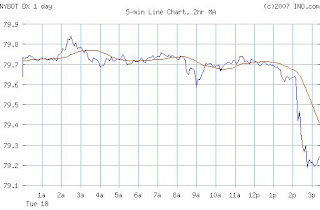
The Federal Open Market Committee decided today to lower its target for the federal funds rate 50 basis points to 4 3/4 percent.
Economic growth was moderate during the first half of the year, but the tightening of credit conditions has the potential to intensify the housing correction and to restrain economic growth more generally. Today's action is intended to help forestall some of the adverse effects on the broader economy that might otherwise arise from the disruptions in financial markets and to promote moderate growth over time.
Readings on core inflation have improved modestly this year. However, the Committee judges that some inflation risks remain, and it will continue to monitor inflation developments carefully.
Developments in financial markets since the Committee's last regular meeting have increased the uncertainty surrounding the economic outlook. The Committee will continue to assess the effects of these and other developments on economic prospects and will act as needed to foster price stability and sustainable economic growth.
Voting for the FOMC monetary policy action were: Ben S. Bernanke, Chairman; Timothy F. Geithner, Vice Chairman; Thomas M. Hoenig; Donald L. Kohn; Randall S. Kroszner; Frederic S. Mishkin; Charles L. Evans; William Poole; Eric S. Rosengren; and Kevin M. Warsh.
In a related action, the Board of Governors unanimously approved a 50 basis point decrease in the discount rate to 5 1/4 percent. In taking this action, the Board approved the requests submitted by the Boards of Directors of the Federal Reserve banks of Boston, New York, Cleveland, St. Louis, Minneapolis, Kansas City and San Francisco.
The dollar got hosed right after this announcement:

Monday, September 17, 2007
Another not so good omen:
Petroleos de Venezuela to Convert Accounts Away From Dollars
Petroleos de Venezuela to Convert Accounts Away From Dollars
By Steven Bodzin
Sept. 17 (Bloomberg) -- Venezuelan President Hugo Chavez instructed Petroleos de Venezuela SA, the state oil company, to convert its investment accounts from dollars to euros and Asian currencies to reduce risk.
The decision may help weaken the dollar as the Federal Reserve prepares to lower interest rates this week, said Philip Wee, an economist at DBS Bank Ltd. in Singapore. The currency has fallen against 14 of the 16 most-active over the past year, partly as governments signaled they may diversify their holdings away from the U.S., the world's primary destination for reserves.
Venezuela moved some of its reserves into euros last year, along with other oil producers including the United Arab Emirates, Kuwait and Qatar. The $50 billion Qatar Investment Authority said Sept. 4 it was looking for options in Asia to counter a weak dollar. China is starting a fund to look for higher returns on some of its almost $1.4 trillion holdings.
``Central banks will be switching more of the dollar into other currencies,'' said Wee, senior currency economist at DBS. ``This should be another negative in a trend that's already set in the interest-rate outlook'' and the Fed may lower borrowing costs to 4.75 percent by year-end from 5.25 percent, he said.
Chavez, speaking in his weekly address on national television yesterday, said the U.S. has bought goods from around the world, paying with paper that is ``a bubble.'' The president said he instructed Energy and Oil Minister Rafael Ramirez to change currencies after the Fed increased the U.S. money supply to alleviate a shortage of cash sparked by concerns about debt backed by sub-prime mortgages.
Iran, China
The dollar traded at $1.3883 per euro at 7:20 a.m. in London from $1.3875 late in New York on Sept. 14. It reached $1.3927 on Sept. 13, the lowest since the single European currency was introduced in 1999. The dollar may weaken to $1.40 per euro by year-end, Wee forecasts.
The world's oil trading system has primarily used dollars for decades. Iran in July requested yen rather than dollars for all shipments to Japan, boosting that currency.
Petroleos de Venezuela had $23 billion in current assets, including $1.88 billion in cash, $848 million in restricted cash and $9.55 billion in accounts receivable, at the end of 2006, according to its audited financial statement. In addition, the company finances the national development fund known as Fonden, which held $27.3 billion as of May 11.
Chavez speaks frequently about the need to increase his country's independence from the U.S., which he calls ``the empire.'' He has sought to diversify his country's customer base for oil by signing supply contracts with Japan and China.
Oil Minister Ramirez said Sept. 11 that Venezuela and China will work together on a $10 billion project to build six refineries and a shipping company to make Venezuela one of China's most important suppliers. Still, the U.S. continues to import 1.36 million barrels a day of crude and refined products from Venezuela, more than half its estimated 2.4 million barrels a day of output.
To contact the reporter on this story: Steven Bodzin in Caracas at sbodzin@bloomberg.net .
http://www.bloomberg.com/apps/news?p...cPI&refer=news
By Steven Bodzin
Sept. 17 (Bloomberg) -- Venezuelan President Hugo Chavez instructed Petroleos de Venezuela SA, the state oil company, to convert its investment accounts from dollars to euros and Asian currencies to reduce risk.
The decision may help weaken the dollar as the Federal Reserve prepares to lower interest rates this week, said Philip Wee, an economist at DBS Bank Ltd. in Singapore. The currency has fallen against 14 of the 16 most-active over the past year, partly as governments signaled they may diversify their holdings away from the U.S., the world's primary destination for reserves.
Venezuela moved some of its reserves into euros last year, along with other oil producers including the United Arab Emirates, Kuwait and Qatar. The $50 billion Qatar Investment Authority said Sept. 4 it was looking for options in Asia to counter a weak dollar. China is starting a fund to look for higher returns on some of its almost $1.4 trillion holdings.
``Central banks will be switching more of the dollar into other currencies,'' said Wee, senior currency economist at DBS. ``This should be another negative in a trend that's already set in the interest-rate outlook'' and the Fed may lower borrowing costs to 4.75 percent by year-end from 5.25 percent, he said.
Chavez, speaking in his weekly address on national television yesterday, said the U.S. has bought goods from around the world, paying with paper that is ``a bubble.'' The president said he instructed Energy and Oil Minister Rafael Ramirez to change currencies after the Fed increased the U.S. money supply to alleviate a shortage of cash sparked by concerns about debt backed by sub-prime mortgages.
Iran, China
The dollar traded at $1.3883 per euro at 7:20 a.m. in London from $1.3875 late in New York on Sept. 14. It reached $1.3927 on Sept. 13, the lowest since the single European currency was introduced in 1999. The dollar may weaken to $1.40 per euro by year-end, Wee forecasts.
The world's oil trading system has primarily used dollars for decades. Iran in July requested yen rather than dollars for all shipments to Japan, boosting that currency.
Petroleos de Venezuela had $23 billion in current assets, including $1.88 billion in cash, $848 million in restricted cash and $9.55 billion in accounts receivable, at the end of 2006, according to its audited financial statement. In addition, the company finances the national development fund known as Fonden, which held $27.3 billion as of May 11.
Chavez speaks frequently about the need to increase his country's independence from the U.S., which he calls ``the empire.'' He has sought to diversify his country's customer base for oil by signing supply contracts with Japan and China.
Oil Minister Ramirez said Sept. 11 that Venezuela and China will work together on a $10 billion project to build six refineries and a shipping company to make Venezuela one of China's most important suppliers. Still, the U.S. continues to import 1.36 million barrels a day of crude and refined products from Venezuela, more than half its estimated 2.4 million barrels a day of output.
To contact the reporter on this story: Steven Bodzin in Caracas at sbodzin@bloomberg.net .
http://www.bloomberg.com/apps/news?p...cPI&refer=news
Sunday, September 16, 2007
From
September 16, 2007
Alan Greenspan claims Iraq war was really for oil
AMERICA’s elder statesman of finance, Alan Greenspan, has shaken the White House by declaring that the prime motive for the war in Iraq was oil.
In his long-awaited memoir, to be published tomorrow, Greenspan, a Republican whose 18-year tenure as head of the US Federal Reserve was widely admired, will also deliver a stinging critique of President George W Bush’s economic policies.
However, it is his view on the motive for the 2003 Iraq invasion that is likely to provoke the most controversy. “I am saddened that it is politically inconvenient to acknowledge what everyone knows: the Iraq war is largely about oil,” he says.
Greenspan, 81, is understood to believe that Saddam Hussein posed a threat to the security of oil supplies in the Middle East.
Britain and America have always insisted the war had nothing to do with oil. Bush said the aim was to disarm Iraq of weapons of mass destruction and end Saddam’s support for terrorism.
Subscribe to:
Posts (Atom)